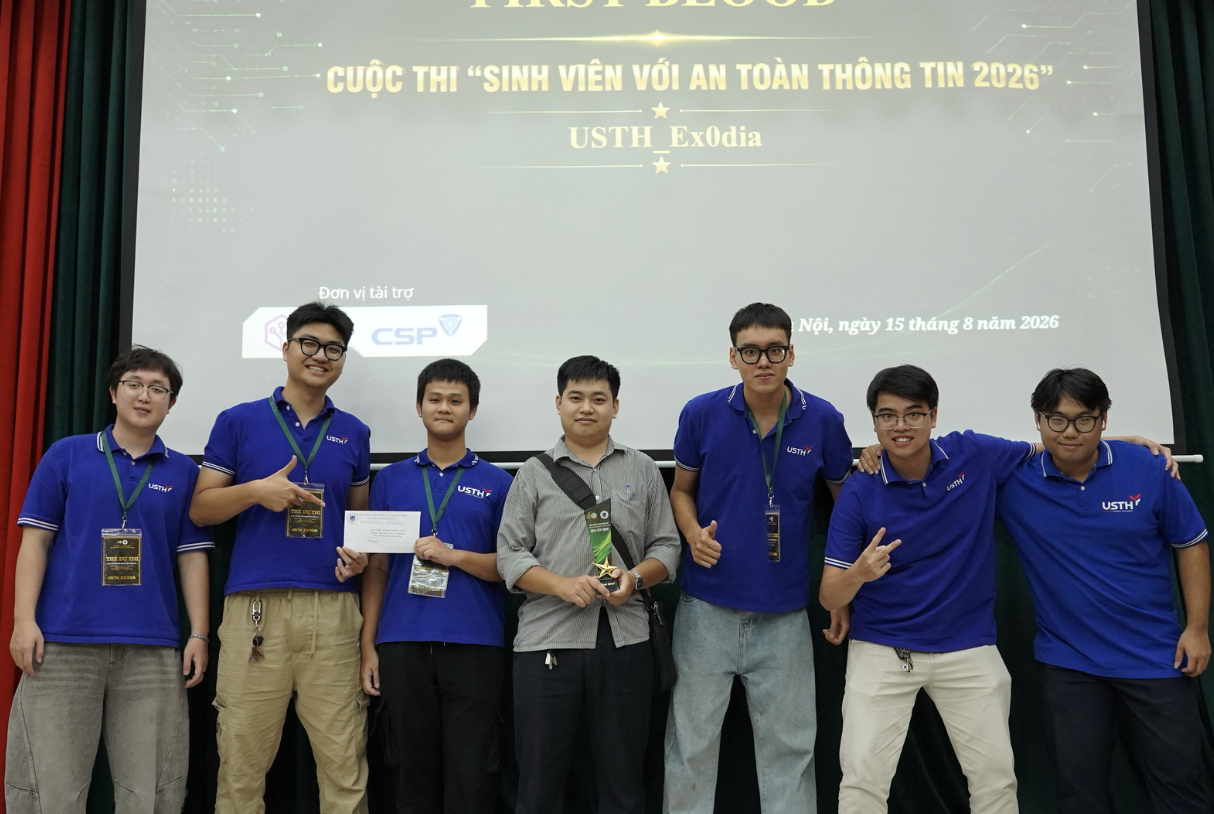
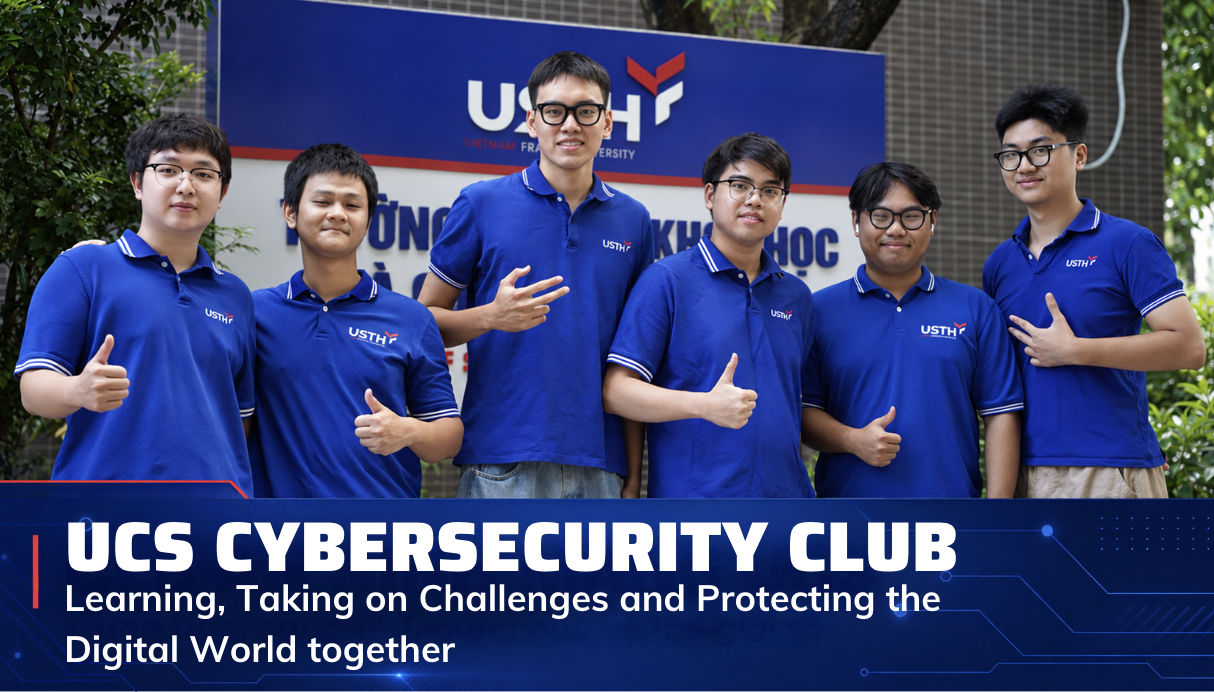
Through their participation in cybersecurity competitions, Le Quang Minh – a third-year Information Security student and President of the UCS Cybersecurity Club – and his teammates discovered a shared passion for exploring and solving cybersecurity challenges. From that common interest, the UCS Cybersecurity Club was established at USTH as a place where students can learn, practise, conduct research, develop tools for vulnerability analysis and cybersecurity competitions, and connect with other young people who share their interest in the field.
The motivation behind UCS

Drawn to computer science and information security from an early age, Le Quang Minh chose to study Information Security at USTH with the desire to gain a deeper understanding of how systems operate, the potential risks that can arise in digital environments, and how data can be protected against cyberattacks.
At USTH, the knowledge Minh gained in the classroom gradually opened up opportunities for him to approach the field from a more practical perspective. Alongside foundational courses, he proactively spent time practising, solving cybersecurity problems and participating in online competitions to sharpen his analytical skills and ability to respond to challenges. In particular, the Cybersecurity Student Contest Vietnam 2025 – organised by the National Cybersecurity Association (NCA) in coordination with the Department of Cybersecurity and High-Tech Crime Prevention under the Ministry of Public Security – was the first specialised competition Minh took part in. The experience helped him realise that mastering theory was only the starting point; applying that knowledge to solve problems under time pressure required a much longer process of continuous practice.
Minh and his teammates were determined to keep pushing beyond what they already knew. In information security, new vulnerabilities can emerge at any time, while attack techniques are constantly evolving. To identify vulnerabilities and protect systems against increasingly sophisticated attacks, cybersecurity practitioners must keep learning and continually challenge themselves with more difficult problems. With this mindset, over the following year, Minh and his teammates actively participated in competitions of different scales. These experiences helped them sharpen their analytical skills, improve their ability to respond and solve problems under time pressure, and build connections with the wider cybersecurity community across Vietnam.
Through countless sessions spent dissecting competition challenges, sharing different approaches and searching for solutions together, Minh and his teammates not only accumulated valuable experience but also recognised the importance of having a shared environment where students could connect, exchange knowledge and support one another’s long-term development. Throughout this journey, USTH consistently encouraged and provided opportunities for students to participate in competitions, giving them more chances to challenge themselves and put what they had learned into practice.
What began as a single competition team gradually grew into two, then three teams as competitive cybersecurity activities at USTH gained momentum. As the number of participants increased, so did the need for a shared space where students could continue learning, practising and progressing together. Minh and his teammates therefore began planning a club for students interested in cybersecurity – a place where learning and hands-on practice would become regular activities rather than something that happened only before competitions. After a period of preparation, UCS – the USTH Cybersecurity Club – was officially established in mid-August 2026.
Three pillars shaping a strong club
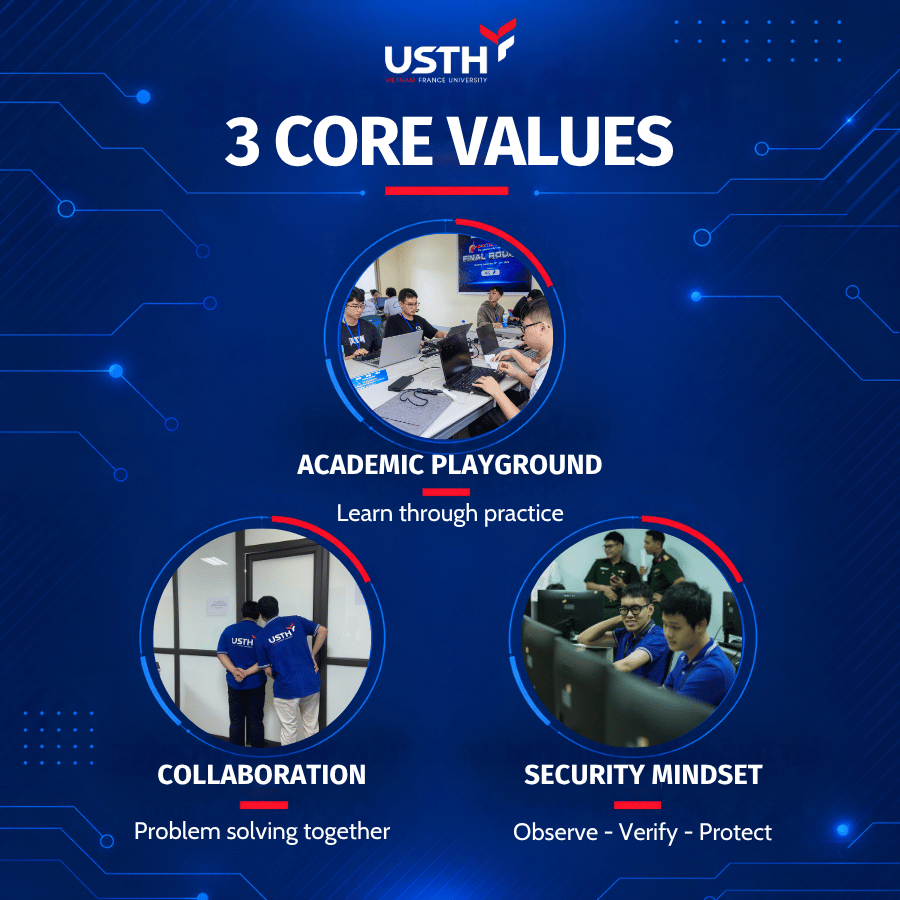
With around 20 founding members, UCS aims to create an environment where students can learn together, share knowledge and apply what they have learned to real-world problems. When establishing UCS, Minh and the founding team chose three core values as the club’s foundation: Playground – Collaboration – Security Mindset.
These values grew directly from the members’ own experiences. Having faced difficulties in finding the right direction when they first started, they wanted to create a clearer starting point for newcomers. Their experiences in learning and competitions also taught them that cybersecurity challenges often require collaboration among people with different strengths. At the same time, through repeated hands-on practice, members gradually develop the habit of observing carefully, identifying unusual signs and verifying information before drawing conclusions.
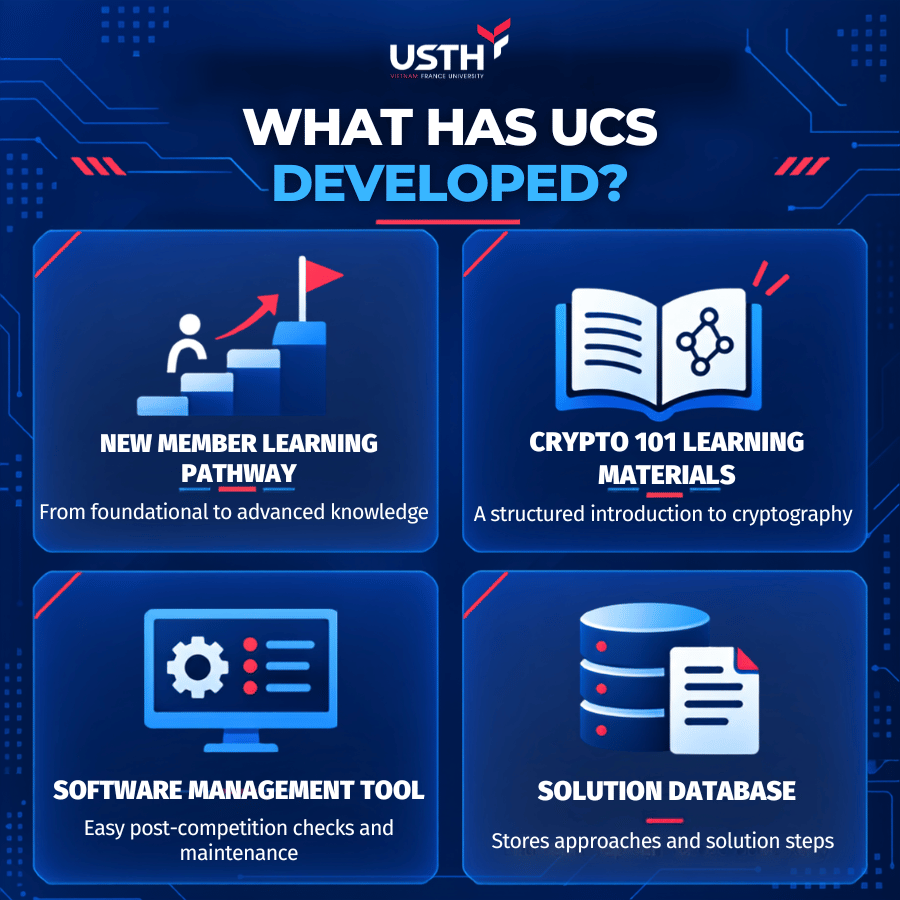
For new members, UCS has developed a learning pathway that progresses from foundational knowledge to more advanced topics. Senior members provide guidance, share learning resources and organise small exercises to help newcomers build their skills step by step. The club has also compiled Crypto 101, a learning resource designed to introduce members to fundamental cryptography concepts in a structured way.
Beyond developing learning materials, UCS members have also created several tools to directly support their learning and competition activities. These include a tool that records specialised software installed on a computer, making it easier for users to check and maintain their setup after each competition, as well as a system for organising data and documenting the approaches and steps used to solve individual challenges. In this way, the experience accumulated by competition teams does not disappear once an event ends, but instead becomes a resource that can be analysed, preserved and shared with new members.
First experiences and the members’ achievements
Among the projects currently under development, BQA stands out as a notable experiment. The tool serves as a bridge between artificial intelligence platforms and computers, allowing AI systems to assist with certain tasks in a virtual environment rather than simply responding to text-based questions. This enables members to use AI more flexibly throughout their learning and hands-on practice. The project demonstrates that UCS members are not simply using existing technologies, but are also actively adapting and developing tools to meet their own needs.
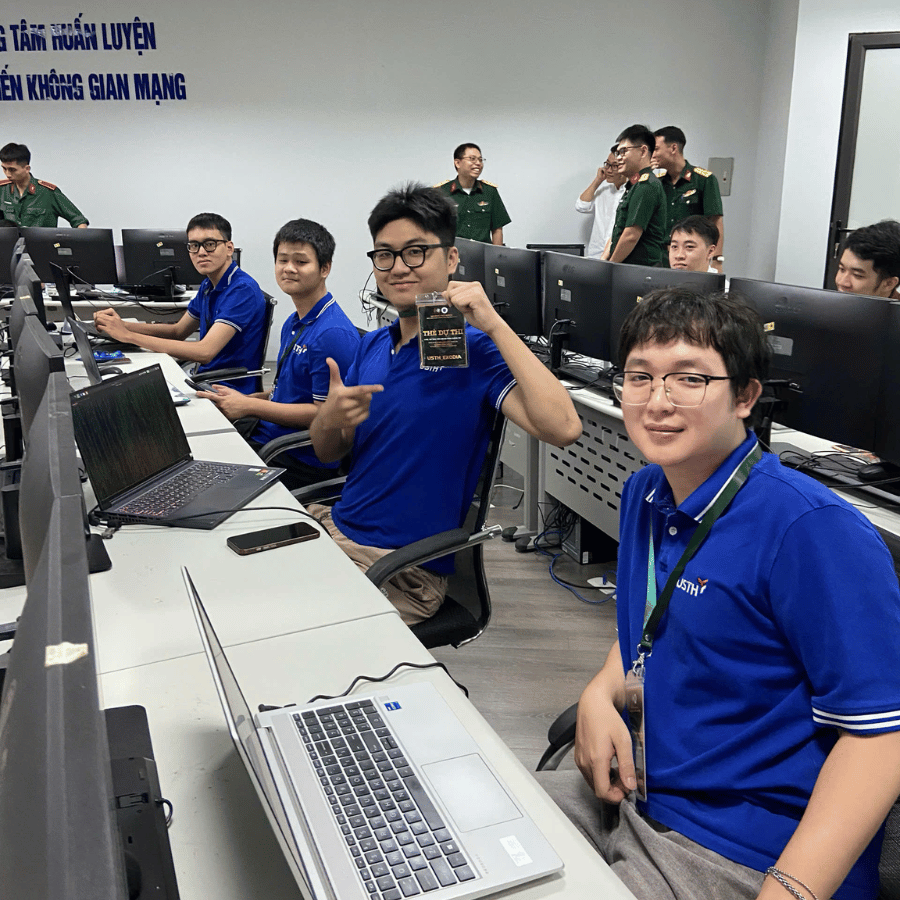
Cybersecurity competitions also provide valuable opportunities for members to test both their knowledge and teamwork. Most recently, at the Digital Dragon CTF 2026 – a high-quality, hands-on competition organised by Evvo Labs for students from Vietnam and across Asia – the team experienced intense nights working through challenging problems.
At one point, members spent 13 consecutive hours, from 2 p.m. until 3 a.m. the following morning, trying to solve one final challenge without finding the answer. The exhausting experience taught them a valuable lesson: technical knowledge is only the starting point. To go further, what matters just as much is perseverance, teamwork and the composure to start again after an approach does not work.
Their hard work paid off when the final results were announced. Competing against strong teams from across the country, UCS made its mark with two teams achieving high overall rankings: one finishing in the Top 4 and the other in the Top 11. More important than the disappointment of leaving one final challenge unsolved, these results reflected the members’ progress, growing confidence and determination to keep moving forward.
Through each competition, learning resource and project, UCS members are gradually building a foundation for the club to continue developing into an active academic community in the field of cybersecurity.
“Don’t be afraid to start when you know nothing”
Looking ahead, Minh and the other members hope to continue developing UCS into a well-structured learning community where USTH students can find resources, guidance and teammates who share the same passion. The club plans to further refine its learning pathway for new members, expand specialised knowledge-sharing sessions and continue researching and developing tools to support learning and hands-on practice.
UCS also aims to build strong competition teams, creating more opportunities for members to apply their knowledge and represent USTH at cybersecurity competitions. However, competition results are not the club’s only goal. In the long term, Minh and his teammates hope to maintain strong connections between generations of members, allowing the experience of those who came before to become a valuable resource for those who follow.
Having once experienced the uncertainty of entering a specialised competition for the first time, Minh understands that every journey needs a starting point.
“Don’t hesitate just because you don’t know anything yet. If you want there to be a next time, there has to be a first time. Without a first time, there will never be any time at all,” Minh shared.
For UCS, daring to take that first step does more than give students an opportunity to learn about cybersecurity. It can also lead them to new teammates and an entirely new journey they may never have imagined themselves beginning.