How can scientists uncover hidden structures inside one of the world’s most iconic ancient monuments without moving a single stone? By combining particle physics, thermal imaging, radar and other non-invasive technologies, researchers are revealing new insights into the Great Pyramid of Khufu in Egypt.
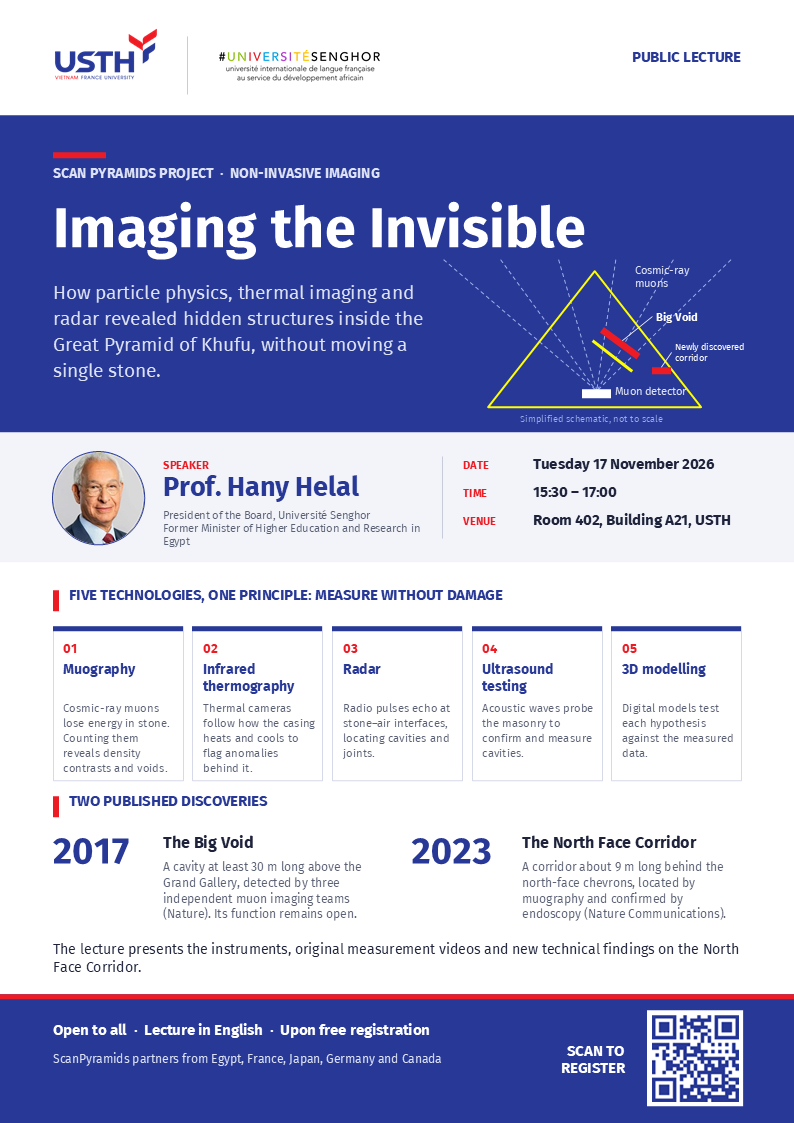
To explore the science behind these discoveries, the University of Science and Technology of Hanoi (USTH), in collaboration with Université Senghor (Operator of Francophonia Organization, Egypt) is organising a public lecture entitled “Inside the Great Pyramid: Science Meets Ancient Mystery.” The event takes place as part of Université Senghor’s visit and working programme at USTH, providing an opportunity to exchange knowledge and explore the intersection of science, technology and cultural heritage.
Exploring the Science Behind the Great Pyramid
The Great Pyramid of Khufu has long fascinated researchers and historians. Beyond its architectural grandeur, the monument continues to hold unanswered questions about its internal structure. Today, advances in modern scientific technologies are offering new ways to investigate these mysteries without causing damage to the ancient structure.
The lecture will introduce the ScanPyramids project and its application of non-invasive imaging technologies to explore the interior of the Great Pyramid. These include muography, which uses cosmic-ray muons to identify variations in density and detect hidden spaces; infrared thermography, which identifies temperature differences that may indicate anomalies behind the pyramid’s casing; and radar, which uses radio pulses to locate cavities and joints. Ultrasound testing and 3D modelling further contribute to examining and validating the findings.
A key focus will be two notable discoveries made through the project. In 2017, researchers identified the Big Void, a large cavity located at least 30 metres above the Grand Gallery. In 2023, the team reported the discovery of the North Face Corridor, an approximately nine-metre-long corridor behind the north face of the pyramid, identified through muography and subsequently confirmed by endoscopy.
Through original measurement videos, scientific instruments and recent technical findings, the lecture will offer insights into how modern science can help uncover hidden features of ancient monuments while preserving their integrity.
Event Information
- Time: 15:30–17:00, Tuesday, 17 November 2026.
- Venue: Building A21, University of Science and Technology of Hanoi (USTH).
- Speaker: Prof. Hany Helal – President of the Board of Université Senghor and former Minister of Higher Education and Research of Egypt.
- Language: English.