Built on excellence and mutual trust, the cooperation between the University of Science and Technology of Hanoi and Université Paris Cité has become a “win-win” model of partnership. This joint interview with leaders from both institutions looks back on a highly effective collaboration.
The partnership between the University of Science and Technology of Hanoi (USTH) and Université Paris Cité (UPCité) is built on academic excellence, mutual trust, and a shared long-term vision. Through jointly designed academic programmes, student and staff mobility, collaborative research, and shared governance, the two institutions have developed a truly mutually beneficial partnership.
Over the past decade, USTH has become a strategic gateway for UPCité in Southeast Asia. The complementarity between the two institutions, strengthened through years of close collaboration, has made this partnership one of the most successful models of university cooperation between Vietnam and France.
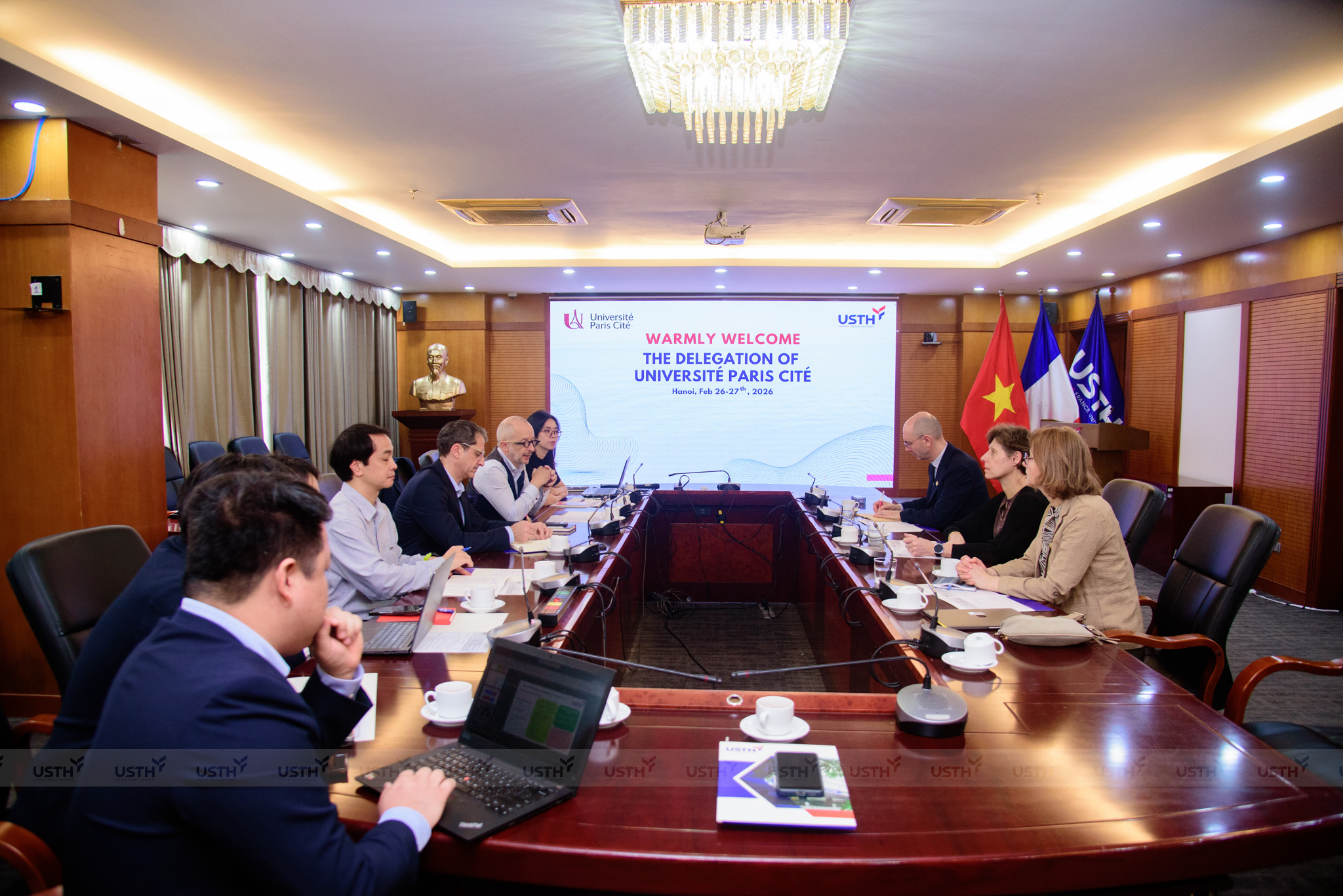
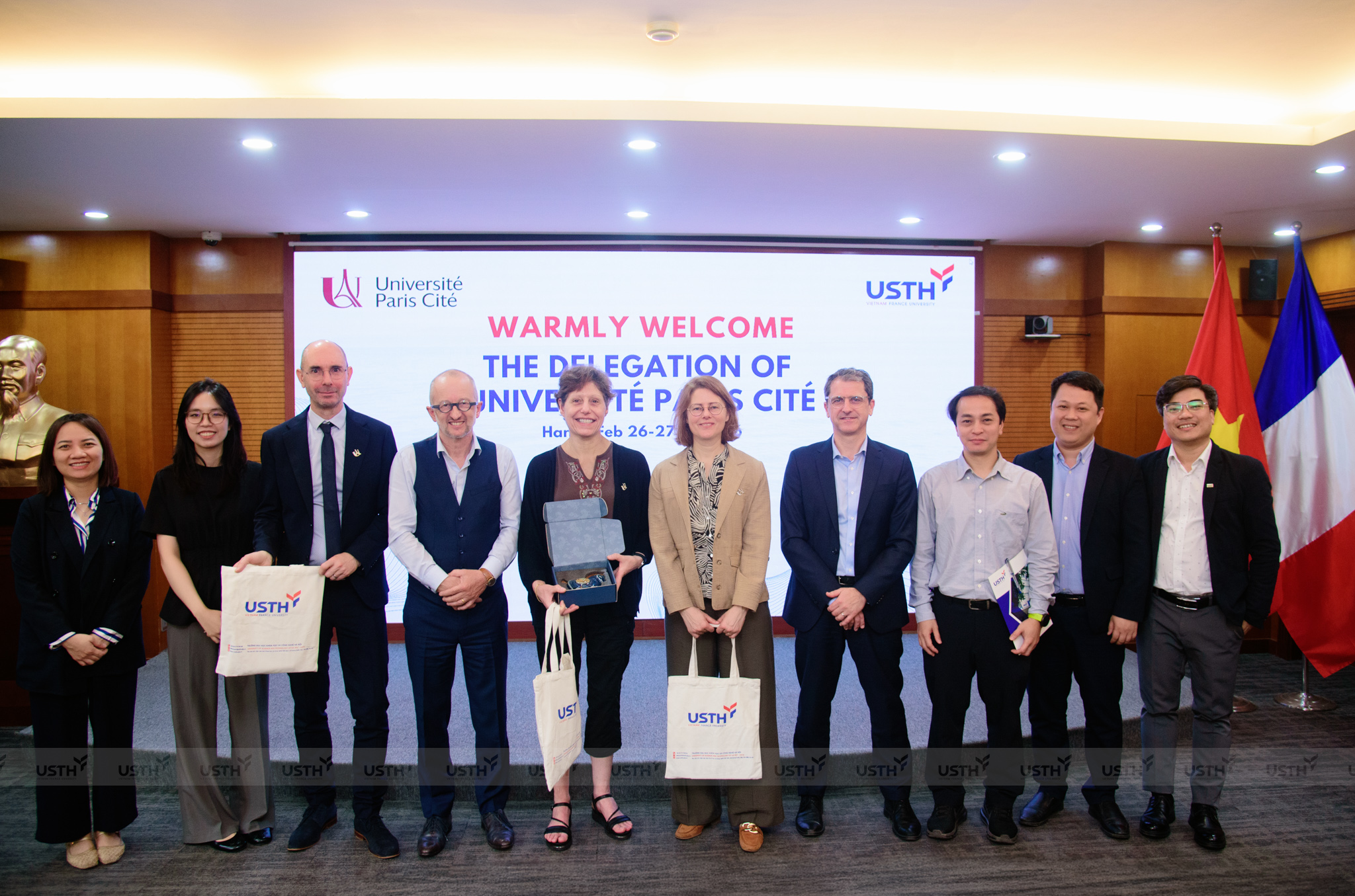
To gain deeper insights into the significance of this partnership, its achievements, and its prospects, Le Courrier du Vietnam spoke with Prof. Antoine Kouchner, Vice President for Strategy and International Relations; Prof. Maximilien Cazayous, Dean of the Faculty of Sciences; Prof. Valérie Serre, Vice Dean of the Faculty of Sciences for International Relations; and Prof. Tran Dinh Phong, Vice Rector of USTH.
How does USTH’s educational model differ from that of traditional Vietnamese universities, and how does it align with UPCité’s standards? What are the main areas of cooperation?
UPCité: USTH’s educational model is built on both Vietnamese and French university standards. It is particularly aligned with UPCité’s standards for three main reasons.
First, the three-year bachelor’s degree follows the LMD structure, which facilitates academic recognition and the development of joint study pathways. Second, teaching in English prepares students for an international environment and makes it easier for them to join binational programmes. Third, the involvement of universities from the USTH Consortium in curriculum development, together with the participation of French lecturers and researchers, ensures close alignment with academic practices in France.
In addition, HCERES accreditation confirms that USTH’s programmes meet French standards and strengthens the confidence of European partners.
As a member of the USTH Consortium since 2010, UPCité has taken part in USTH’s governance, particularly through the co-leadership of two professors in the Department of Advanced Materials Science and Nanotechnology (AMSN).
Each year, around 20 UPCité lecturers and researchers undertake teaching missions at USTH, contributing to knowledge transfer and academic supervision.
On a day-to-day basis, the administrative and academic teams of both institutions work together to implement academic standards, manage mobility, conduct assessments, and ensure programme quality.
The SPACE master’s programme, which focuses on satellite engineering and astrophysics, and the AMSN master’s programme, which focuses on nanotechnology, are led by UPCité’s Faculty of Sciences and co-accredited by both institutions.
How were these fields chosen?
UPCité: The specialisations of the two co-accredited master’s programmes connect Vietnam’s strategic priorities with UPCité’s areas of excellence.
The SPACE master’s programme, led by the Physics Department of UPCité’s Faculty of Sciences, addresses key issues in space science, astrophysics, and satellite technologies. The AMSN master’s programme, led by the Chemistry Department, focuses on nanoscience and advanced materials.
Building on UPCité’s scientific excellence, these programmes aim to train highly skilled talent in Vietnam who can meet the development and innovation needs of these strategic sectors.
How does the double-degree system work in practice? Why was USTH chosen as UPCité’s strategic partner in Vietnam?
UPCité: The system is based on a clear academic agreement. Study pathways, selection procedures, assessment methods, and validation requirements are jointly defined. Once students meet all requirements, each university awards its own degree in accordance with its national regulations. This mechanism ensures programme quality and the bilateral recognition of students’ academic pathways.
The choice of a single strategic partner in each country is based on institutional and scientific alignment. USTH and UPCité chose each other. For us, USTH offers an agile model, a strong position in Vietnam, international governance, and a solid research foundation.
These factors have helped build lasting trust and a shared academic vision. At the same time, they do not prevent UPCité from cooperating on a smaller scale with other Vietnamese institutions in areas such as mobility and research.
How do you encourage UPCité students to join master’s programmes delivered in Hanoi?
UPCité: The creation of double bachelor’s degrees, the hosting of UPCité students for research internships in USTH laboratories or at the Vietnam Academy of Science and Technology (VAST), the organisation of summer schools, and the development of jointly supervised PhD programmes are all highly promising ways to strengthen cooperation between the two institutions.
Located in a rapidly growing country, USTH offers our students the opportunity to study and work in a dynamic, international scientific environment. This experience is a major asset academically, professionally, and interculturally.
How do co-accredited master’s degrees help students move on to jointly supervised PhD programmes in UPCité laboratories?
UPCité: USTH is an excellent example of Franco-Vietnamese university cooperation. Through co-accredited programmes and the mobility of students and researchers, this partnership promotes French scientific excellence in a rapidly developing country.
By training highly qualified Vietnamese students according to French standards, we enhance the attractiveness of the French academic model. The co-accredited master’s programmes naturally pave the way for jointly supervised PhD programmes. These programmes train scientists who are familiar with two academic environments and help build long-term binational research networks.
What role does the partnership between the two institutions play in advancing Vietnam–France university cooperation? How does it contribute to educating and training the next generation of scientists, engineers, and experts?
USTH: In 2009, UPCité co-founded the USTH Consortium. Since then, it has actively contributed to USTH’s development through five strategic actions: training our lecturers, jointly accrediting master’s programmes, sending professors to teach, hosting bachelor’s, master’s, and PhD students for internships or joint supervision, and conducting joint research. UPCité is therefore one of our major international partners.
This long-standing and fruitful cooperation in both training and research demonstrates that the bilateral partnership is an exemplary success in Vietnamese-French university collaboration.
Thanks to its world-renowned laboratories, UPCité has trained many talented USTH lecturers. Several of them, now recognised for their scientific expertise, currently hold key positions at the university.
We believe that UPCité, together with other French partners, will continue to support the training of our future scientists and engineers in key fields such as biotechnology, materials science, space science, earth science, and chemistry. We are also developing training and research activities in pharmacy and health sciences, and we strongly count on the support of our French partner.
What are Vietnam’s priority areas for science and technology development—and, consequently, USTH’s strategic priorities—in which Université Paris Cité is already involved or could play a greater role in the future? What benefits will the agreement between Université Paris Cité and VAST bring to USTH, particularly in the areas of research and innovation?
USTH: The Vietnamese Government has recently identified ten priority technology groups, including artificial intelligence, communications, robotics, biotechnology, advanced materials, energy, semiconductors, cybersecurity, aerospace, marine technologies, and high-speed rail.
USTH and UPCité are already working closely together in advanced materials, space and earth sciences, and biotechnology. Discussions are underway to expand this partnership to research and training in biomedical technologies and semiconductors.
The MoU between UPCité and VAST confirms their shared commitment to developing research and innovation. This partnership involves USTH, a long-standing partner, as well as other VAST institutes in physics, materials science, and chemistry. With the support of VAST, USTH will play a catalytic role in this cooperation.
Last year, a scientific school on advanced materials for medical applications was co-organised by the French National Centre for Scientific Research (CNRS) and VAST. It brought together scientists from UPCité, USTH, and several VAST institutes. Following this event, researchers submitted a joint proposal to CNRS for an international research project to build a long-term collaboration.
What are the advantages of USTH’s LMD-ECTS model for students? How do these research collaborations support USTH’s strategic ambitions and contribute to the implementation of Politburo Resolution No. 57 on the development of science and technology, innovation, and digital transformation?
USTH: USTH uses the ECTS credit system and teaches in English. Its HCERES accreditation in 2023 confirms that the university meets European standards. These distinctive advantages make USTH an attractive partner for European universities and grandes écoles.
The number of international students coming to USTH for double degrees, exchanges, and three- to six-month internships is increasing. Conversely, USTH students can integrate easily into similar programmes in Europe. We now aim to attract more students from Southeast Asia.
The Vietnamese Government has made science and technology a strategic priority and is investing significant resources in these areas. Despite limited resources, Vietnamese scientists have delivered impressive achievements. Nevertheless, further efforts are needed to close the gap with international standards.
Conducting joint research with UPCité scientists, who are at the forefront of several fields, as well as with other leading partners such as CNRS, IRD, and CEA, offers excellent opportunities for USTH researchers in both research and training.