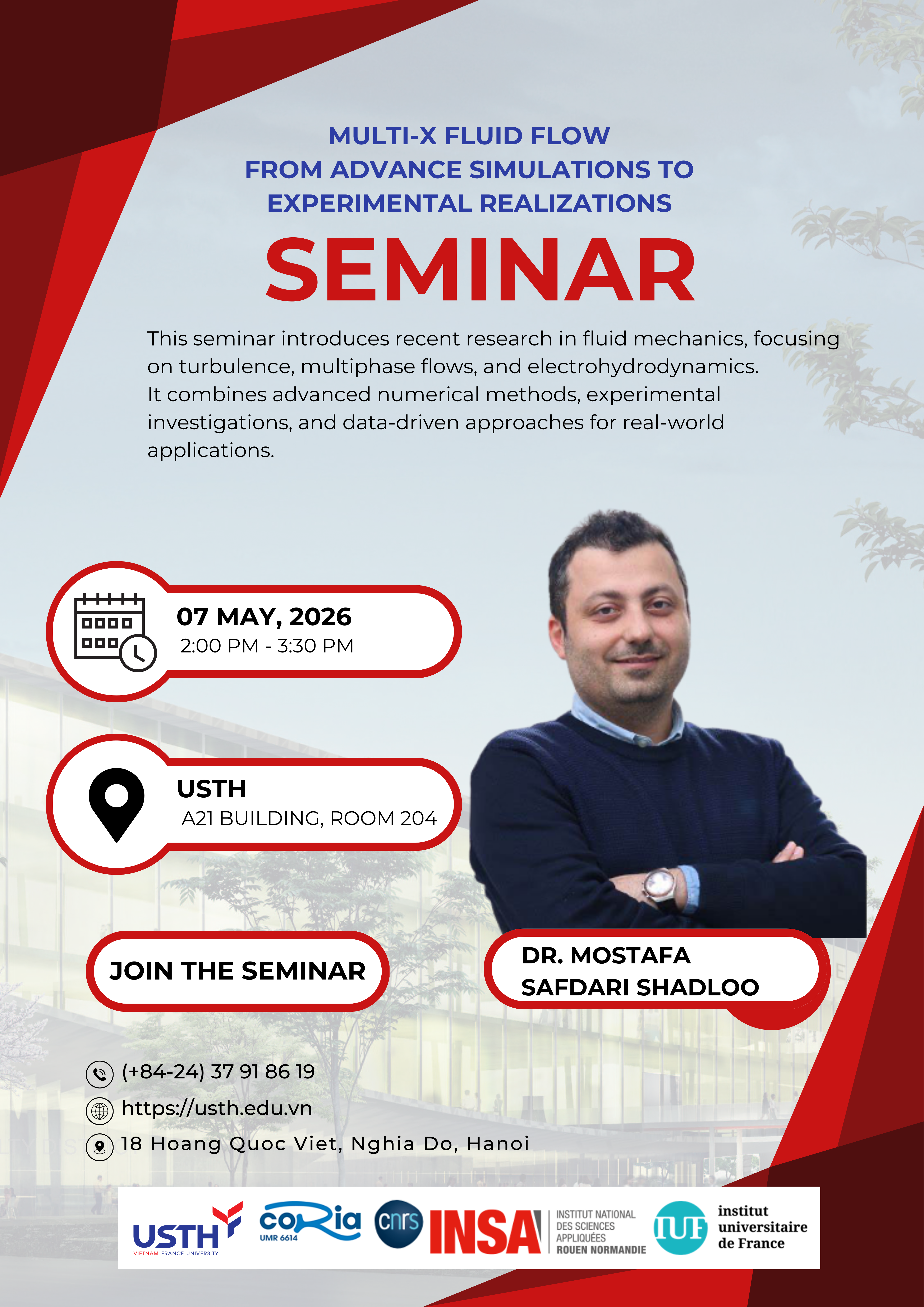
Dr. Shadloo is a leading researcher in fluid mechanics and CFD, serving as Deputy Director of CORIA/CNRS and Full Professor at INSA Rouen, France. An Institut Universitaire de France Laureate, his work focuses on turbulence, electrohydrodynamics, and AI in fluid dynamics. With over 9,000 citations (h-index 57), he ranks among the top mechanical and aerospace scientists in France.
He earned his PhD from Sabanci University and habilitation from the University of Rouen. His research spans fundamental and applied fluid dynamics, including a patented electrohydrodynamic separation system. He has led international projects exceeding €3M and collaborated with institutions such as Stanford and Imperial College London.
He has supervised over 60 trainees, including 12 PhDs, and teaches CFD, heat transfer, and turbulence globally. Recognitions include the Humboldt Fellowship and Stanford’s top 2% scientists list. He has published over 120 ISI-indexed papers in journals like Journal of Fluid Mechanics and Physics of Fluids, bridging theory with industrial applications in energy and sustainability.
For more details, visit his personal website.
In this seminar, Pr Safdari Shadloo will present his research activities in the field of fluid mechanics, with a particular focus on turbulence, multiphase flows, and electrohydrodynamic. His work combines high-fidelity numerical methods such as CFD, Lattice Boltzmann Method (LBM), and Smoothed Particle Hydrodynamics (SPH) with advanced experimental investigations and high-performance computing. He will highlight recent developments in modeling interfacial dynamics, electrohydrodynamic instabilities, and heat and mass transfer, as well as his contributions to multi-physics coupling strategies enabling accurate predictions across scales. Special emphasis will be placed on bridging fundamental understanding with practical applications in energy systems, environmental processes, and advanced fluid engineering.
He will also discuss ongoing and recent projects where these approaches are integrated with data-driven methods, including machine learning techniques for reduced-order modeling, optimization, and predictive control of complex flows. Examples will include electrohydrodynamic-based separation technologies, pore-scale reactive transport in porous media, and thermally driven multiphase systems. The seminar will underline how these research efforts are structured around strong interdisciplinary collaboration, combining physics-based modeling, numerical innovation, and experimental validation, ultimately aiming to deliver robust, callable solutions for industrial and societal challenges.
Affiliation:
Process Engineering and Risk Management Department (GPGR)
Turbulence, Atomization, Spray & Chaos Group, CORIA Lab. CNRS-UMR 6614, France