On June 15 2026, the Department of Life Sciences (LS) held a graduation thesis defense for French students in the double-degree program currently studying in their third year at USTH. This marked the final assessment closing out a one-year academic journey, which included three months of research conducted by the students within Vietnam’s academic environment.
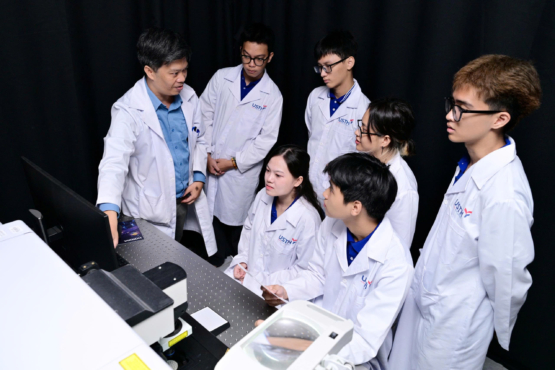
During the internship semester, students carried out research and experiments in USTH’s laboratories on topics centered on key areas of life sciences, including drug development from medicinal materials, genetic and vaccine technology, and solutions to address antibiotic-resistant bacteria.
The process required students to run practical experiments, build solid theoretical frameworks and analyze data to reach final scientific conclusions for their topics.
The thesis defense before the Faculty Committee
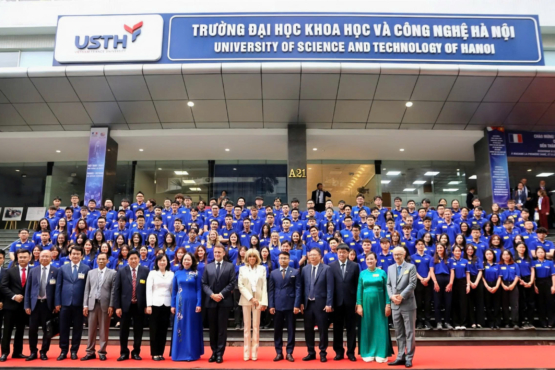
The defense took place with the participation of the Graduation Thesis Examination Committee of the Faculty of Life Sciences, along with students and friends.


Following each presentation, committee members provided feedback, suggestions, and guidance to help students further develop their research topics in the future.
Student reflections after the thesis defense
The students felt they had performed well in conveying their research content and the data gathered during their internship.
Lilou Crea shared that before the defense, she felt quite nervous and tense. But once it began, her focus on the content took over everything — and time passed faster than she expected. She also praised the quality of feedback from the committee, finding the lecturers’ comments constructive and practical.
Meanwhile, Jean Le Vessier rated his own presentation performance as fairly good, 7 out of 10 relative to his expectations. He added that because he had prepared thoroughly and had a deep, solid grasp of his topic, he wasn’t overly nervous facing the committee’s questions. He was especially struck by the defense itself, finding it thrilling to gain new perspectives and a wider range of possible solutions for his project through the discussions and questions raised by the lecturers.
A supportive learning and research Environment at USTH
The students expressed their deep gratitude for the support from their supervisors and the French-Vietnamese student community throughout their research.
Noé Giraud-Audine shared that throughout the research process and thesis writing, lab technician Hồng Ngọc (a USTH alumna) closely accompanied and dedicatedly supported him at every stage. What Noé valued was not only the technical support but also the way she guided his thinking — from the overall picture of the project down to the specific reasons behind each step. This big-picture-to-detail approach helped him truly understand what he was doing and why, laying the foundation for building independent research thinking rather than passively following instructions.
For Jean Le Vessier, one practical advantage of the USTH environment that impressed him was that classrooms, labs, and faculty offices are all located within the same campus, cutting down travel time and making it easy to discuss and resolve questions as soon as they arose during experiments.
The thesis defense successfully wrapped up the academic exchange journey of the French double-degree students at USTH. After a productive period of research, experimentation, and collaboration in Vietnam’s scientific environment, the students fulfilled all academic requirements. They will leave USTH with valuable hands-on experience and a strong research foundation for their future academic journeys.