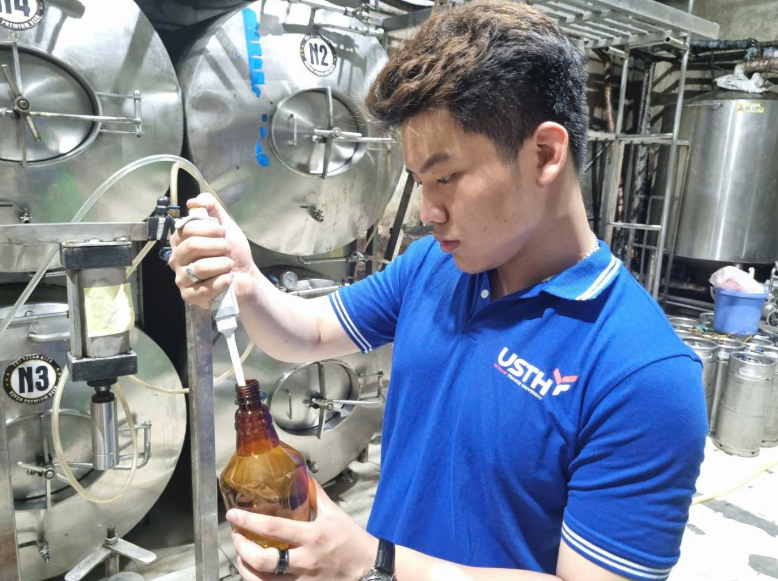
Recently, 12th-cohort students of the Food Science and Technology (FST) programme at the University of Science and Technology of Hanoi (USTH), under the guidance of Dr. Pham Hoang Nam, took part in a professional practical training at FBT Brewery, one of Hanoi’s pioneering craft beer producers. This activity is part of FST – USTH’s work-integrated learning strategy, designed to give students direct exposure to professional food and beverage production environments.
Understanding the Process – Getting the Fundamentals Right
The training opened with a comprehensive introduction by FBT’s technical team to the core brewing process, covering its main stages: malt milling and raw material preparation, mashing and lautering, boiling and hopping, fermentation, and conditioning and packaging. This technological framework forms the shared foundation of both craft and industrial beer production.
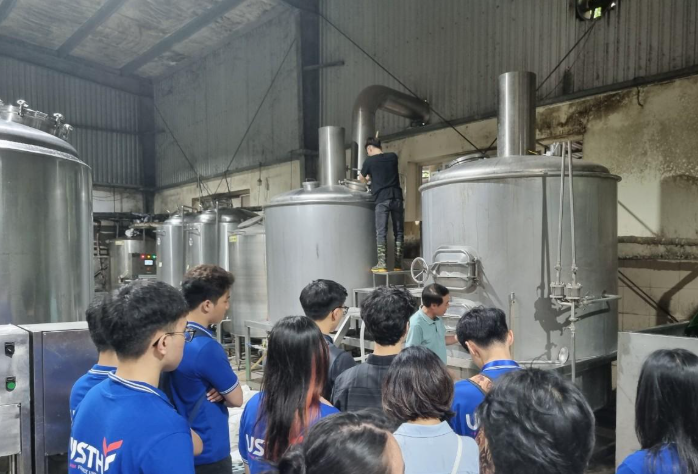
Despite operating on the same fundamental principles, the two production models differ substantially in scale, recipe development flexibility, and ingredient philosophy – craft brewing prioritizes creativity, product character, and raw material quality over cost optimization and batch uniformity. This distinction offered students a valuable and professionally formative perspective from their very first encounter with real-world production.
Ingredient Selection – The Foundation of Quality
Before moving into hands-on operations, students explored FBT’s ingredient sourcing philosophy – covering barley malt, hop varieties, and specialized yeast strains selected for specific beer styles. The key takeaway was a principle central to food science and technology: the quality of raw materials is a critical determinant of final product quality.
Direct Operation – Hands-On Training at Every Production Stage
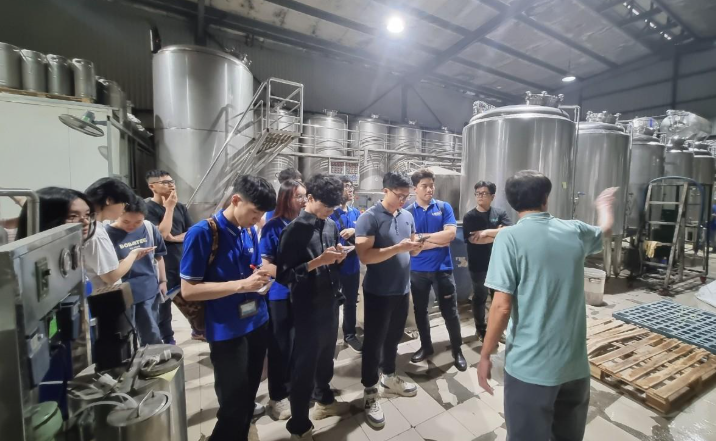
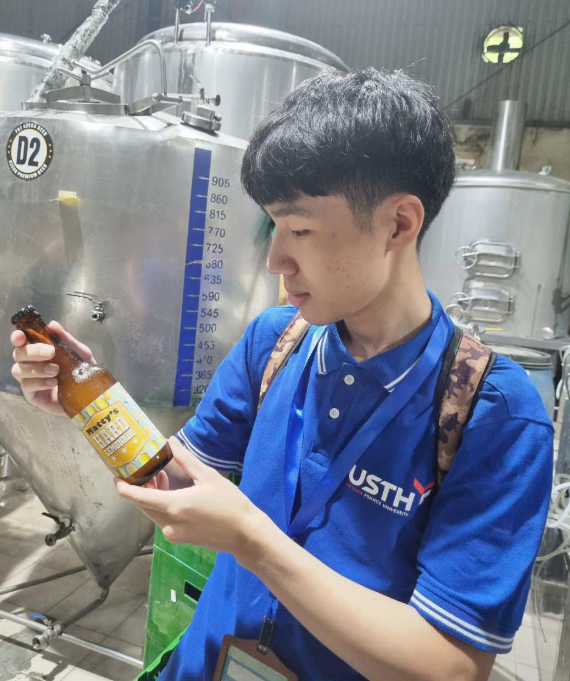
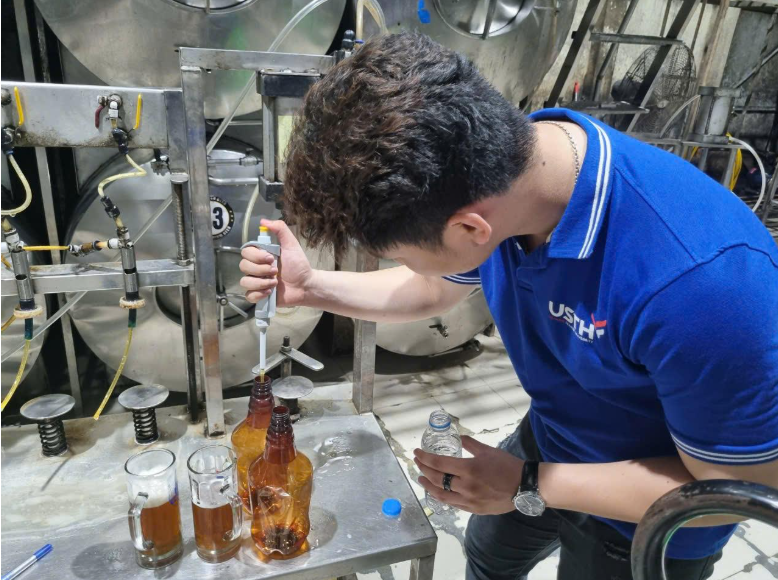
Building on this foundation, Gen 12 FST students directly operated equipment and carried out technical procedures at each production stage under the close supervision of FBT’s technical staff. At the brewing stage, students operated the mash tun and brew kettle systems, monitored and adjusted mashing temperatures, and assessed the degree of starch conversion using an iodine qualitative test on wort samples. At the fermentation area, they operated tank sampling valves, used a hydrometer to monitor fermentation progress via specific gravity readings, and conducted sensory evaluation of the beer at successive stages of the process. Students also performed hands-on inspection and operation of equipment at dedicated working positions within the brewhouse system, gaining direct familiarity with the design and operating principles of the full production line. Additionally, they analysed technical information on product labels currently in production at the facility, including assessing colour using the European Brewery Convention (EBC) scale, Alcohol By Volume (ABV), International Bitterness Units (IBU), ingredient declarations, and beer style classifications. Notably, students also conducted sensory evaluation of FBT’s craft beer products – assessing appearance, clarity, aroma, and taste – directly applying the organoleptic analysis skills acquired through their academic training to real finished products.
Active Learning – Connecting Academic Training with Industry Reality
Throughout both sessions, FST students demonstrated a rigorous and proactive approach: taking detailed notes, collecting field documentation, and posing in-depth questions to FBT’s technical team on quality control, yeast strain management, by-product handling, and process parameter optimization. FBT’s technical staff generously shared practical insights that only an active production environment can provide.
A Lasting Bridge Between Academia and Industry
The FBT training visit is a clear reflection of the FST – USTH programme’s educational philosophy: building a strong connection between academic knowledge and industry practice, and equipping students with the practical competencies they need to enter the workforce with confidence upon graduation.