“What takes you further is not how many remarkable pieces you have, but how well you understand them and patiently put them together to create your own path.”
For Hoang Le Ha Phuong, former top graduate of the Medical Science and Technology programme at USTH in 2026, the prestigious France Excellence Eiffel Scholarship was not the result of a flawless application. Rather, it reflected years of steadily building knowledge, gaining hands-on laboratory experience, and gradually shaping her own academic direction. This journey has brought Phuong to the Master’s programme in Cancer Biology at the University of Bordeaux, France, where she continues to pursue her ambition of contributing to better human health.
Your starting point does not define your limits
When Phuong first began studying Medical Science and Technology, her foundation in the natural sciences was still limited. Rather than being discouraged by the sheer volume of new knowledge, she chose to take an active approach to learning. She carefully studied fundamental concepts through textbooks and created detailed mind maps to break down complex topics and understand their underlying principles.
This approach gradually became her own learning method. As she adapted to the demands of university life, Phuong also found support and encouragement from her friends. The saying, “If you want to go fast, go alone; if you want to go far, go together,” proved particularly true through her experience. Independent learning helped her make progress, while friendship gave her the strength to persevere throughout the journey. Her achievements, including the Academic Encouragement Scholarship, the Odon Vallet Scholarship, and graduating as the top student in her programme, were the fruits of those persistent efforts.
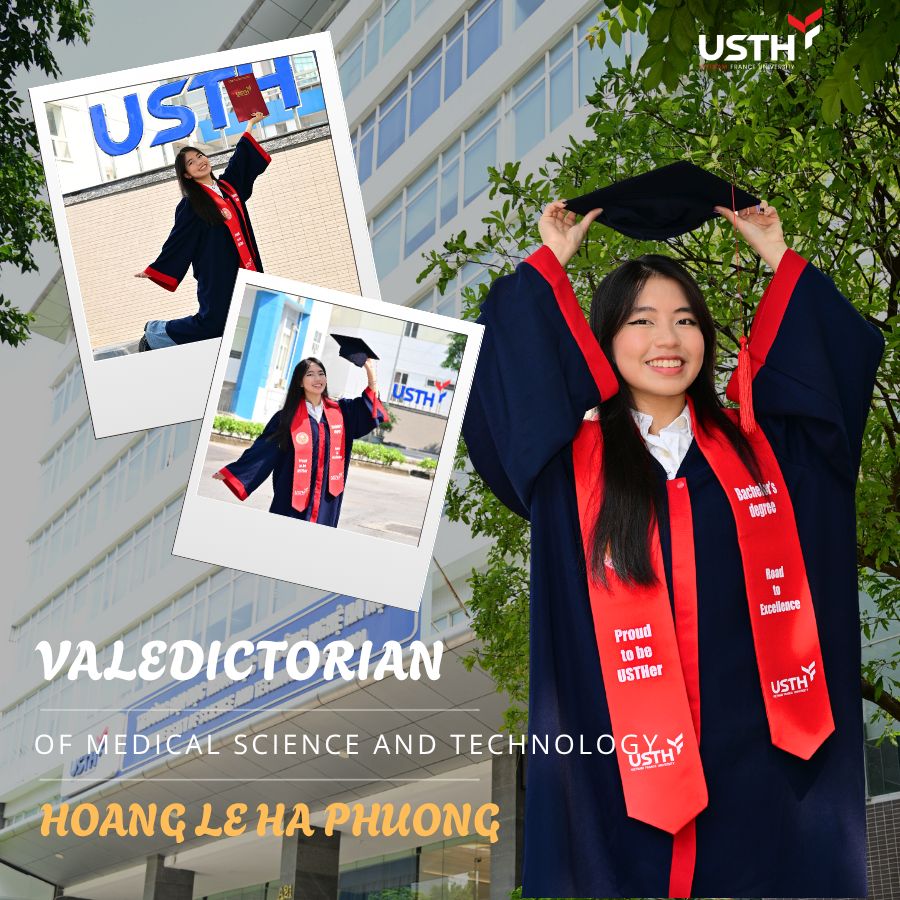
“I believe that understanding the underlying principles is extremely important in every field, especially in scientific research,” Phuong shared.
This way of thinking became the foundation for the next steps in her academic journey.
From questions in the laboratory to a commitment to society
Science does not exist solely within the pages of textbooks. It was not until Phuong put on her lab coat and began an internship at the Vietnam Military Medical University, followed by an exchange semester at Chang Gung University of Science and Technology, that she truly experienced scientific research firsthand.
Standing before microscopes and biological data, she began asking questions about the molecular processes behind cancer development, progression, and resistance to treatment. Through these experiences, her scientific curiosity gradually grew into a sense of social responsibility. For Phuong, breast cancer and gynaecological conditions were not merely medical challenges; they also placed considerable psychological and financial burdens on women, particularly in developing countries such as Vietnam. Recognising these challenges, the top graduate in Medical Science and Technology became increasingly determined to pursue early, less invasive diagnostic methods that could help patients receive more effective treatment.
Her research experiences at Chang Gung University of Science and Technology during her time at USTH, together with her internship at the Vietnam Military Medical University, helped Phuong move beyond learning in the classroom to actively asking questions, investigating problems, and addressing challenges in the laboratory. The research methodology and practical skills she had developed at USTH also gave her greater confidence in an international academic environment, enabling her to communicate proactively with professors and learn from fellow laboratory members.
Through this process, Phuong not only strengthened her research capabilities but also gained a clearer understanding of her long-term academic goals, leading her to pursue further studies in Cancer Biology at the Master’s level.
With a clearer direction in mind, choosing a Master’s programme was no longer simply about finding an opportunity to study abroad. Phuong was looking for a programme that would allow her to deepen her knowledge of cancer biology, molecular biology, cell biology, and experimental research methods. These were essential foundations for pursuing the questions that had emerged from her hands-on research experience. After exploring the curriculum and research orientations of different programmes, the Gen 14 alumna chose to pursue a Master’s degree in Cancer Biology at the University of Bordeaux.
The France Excellence Eiffel Scholarship came into the picture during this search. Having first learned about the scholarship through USTH alumni from previous cohorts, Phuong saw Eiffel as more than financial support; it was an opportunity to study in France’s advanced research environment. After assessing her academic achievements, research experience, and personal goals against the scholarship’s criteria, she decided to take on the challenge.
For Phuong, the greatest challenge when writing her Eiffel scholarship application was not how to showcase her achievements, but how to connect seemingly separate milestones into a coherent picture – one in which every experience helped point towards the next step in her academic journey.
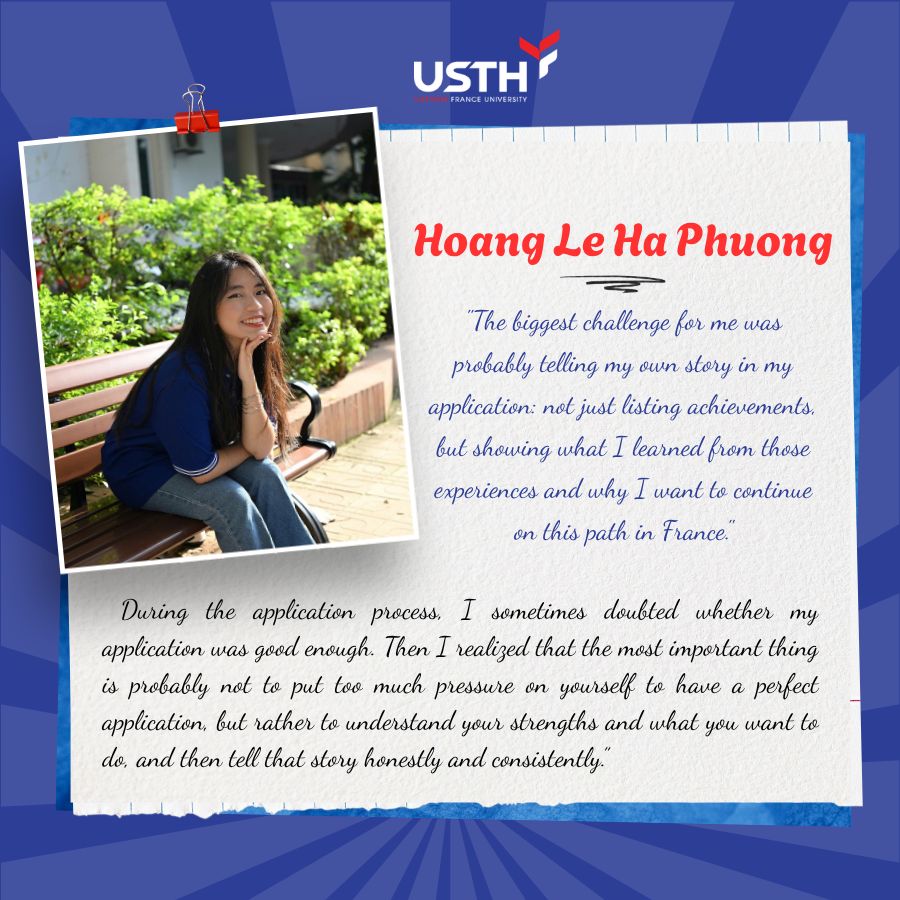
Behind her gentle and bright appearance is an independent personality with a clear sense of purpose. Although she may not always have all the answers, Phuong knows how to patiently explore what interests her, set her own goals, and work towards them step by step. Her Eiffel scholarship application was therefore not an isolated decision, separate from her years at USTH, but a natural continuation of the questions and interests nurtured through her studies and research.
“Don’t be afraid to take on a challenge before you feel ready”
Looking back on her journey, the Gen 14 alumna has a message for current and future generations of USTH students: there is no need to put too much pressure on yourself to define your exact career path during the first years of university. Instead, see your university years, academic experiences, and internships as opportunities to explore, understand yourself better, and adjust your direction when needed.
For students seeking scholarship opportunities, Phuong believes the key is to remain committed to the subjects and questions they genuinely care about, while building an authentic story around their personal and academic journey.
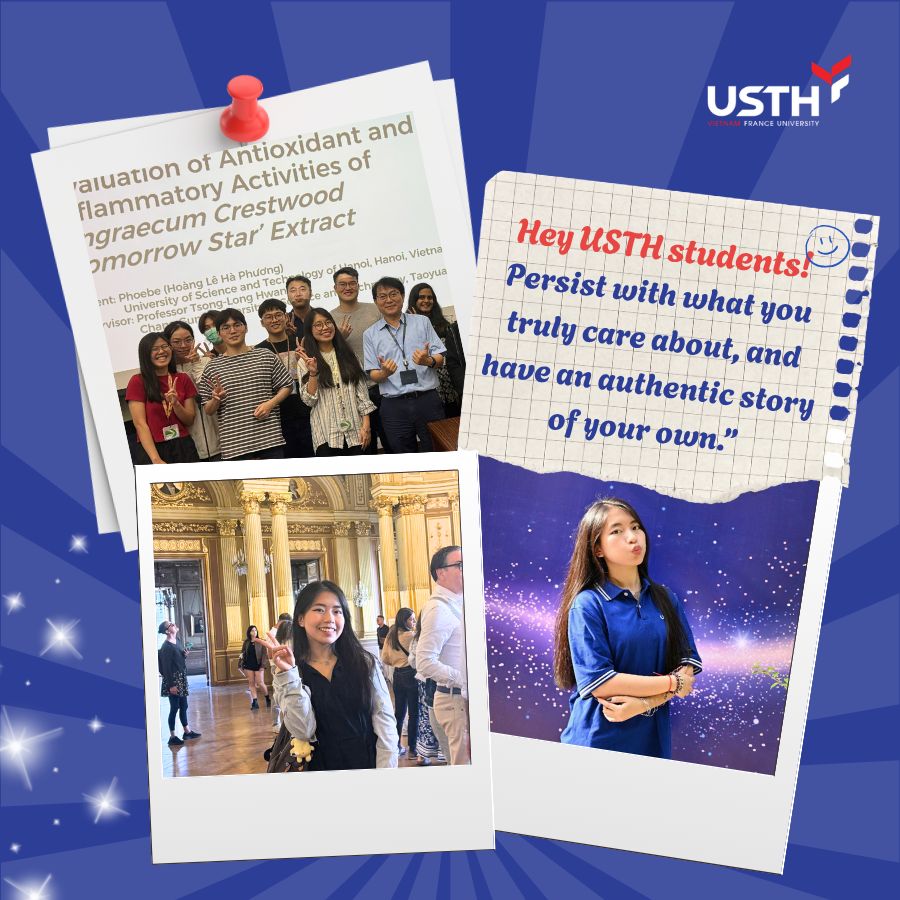
Ahead of Hoang Le Ha Phuong lie two promising years of study and research in France. Looking back on the path she has taken, the USTH top graduate has shown that “your starting point does not determine your destination. Perseverance, the right approach, and genuine passion are what open the way to the world.”
France Excellence Eiffel: A golden ticket to France for USTH students
Ha Phuong’s story is one example of the international study opportunities available to USTH students. Funded by the French Ministry for Europe and Foreign Affairs, the France Excellence Eiffel Scholarship aims to attract outstanding international students to Master’s and PhD programmes in France.
The scholarship provides a monthly living allowance, round-trip airfare, insurance, and support related to accommodation. Applicants cannot submit their applications directly; instead, they must be nominated by a French higher education institution. With its European-standard education and network of academic partnerships in France, USTH provides students with opportunities to prepare their applications and access these international scholarship programmes.
France Excellence Eiffel Scholarship 2027 Timeline
- October 2, 2026: Scholarship application period opens.
- October–December 2026: Prepare application documents and contact French universities for nomination. Deadlines vary by institution.
- January 6, 2027: Deadline for French institutions to submit nominated applications to Campus France.
- Week of April 12, 2027: Scholarship results are expected to be announced via email.
For USTH students considering postgraduate studies in France, the first steps include exploring suitable academic programmes, identifying research interests, and discussing application plans with lecturers well in advance. A strong application is built not only on outstanding achievements but also on thorough preparation and a clear academic direction.