1. GENERAL PROGRAMS
| Programme Title (English) | Food Science and Technology |
| Programme Title (Vietnamese) | Khoa học và Công nghệ Thực phẩm |
| Abbreviation | FST |
| Programme Code | 7540101 |
| Award | Bachelor of Science (B.Sc.) |
| First Enrolment | 2016 |
| Total Credits Required | 180 ECTS |
| Duration | 36 months / 48 months
(with optional intensive English preparatory year) |
| Language of Instruction | 100% English |
| Host Department | Department of Life Sciences, USTH |
2. PROGRAM OVERVIEW
Food science and technology today plays a critically important role in the development, diversification, and value enhancement of agricultural, forestry, and aquatic products, capitalising on Vietnam’s rich and abundant natural resources. In parallel, the growing societal demand for clean and safe food and agricultural products has created an urgent need for the training and development of human resources equipped with both solid domain expertise and strong professional ethics. The current supply of high-quality graduates in food science and technology in Vietnam remains insufficient to meet the increasingly competitive demands of the market. The Bachelor’s programme in Food Science and Technology at USTH aims to address this talent shortage at the advanced level.
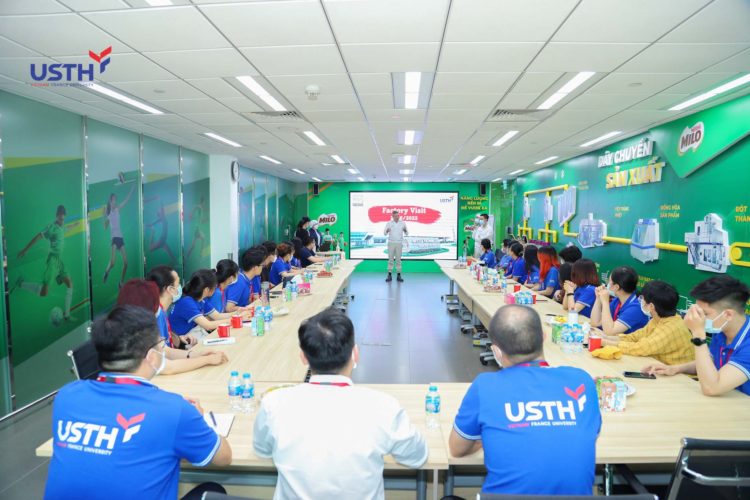
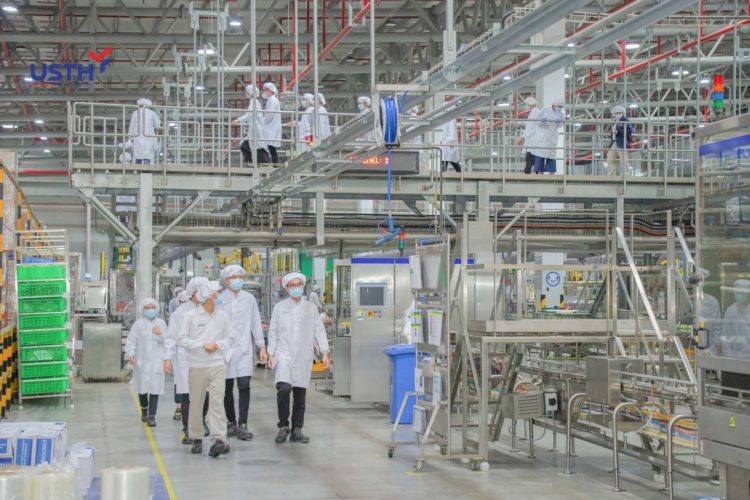
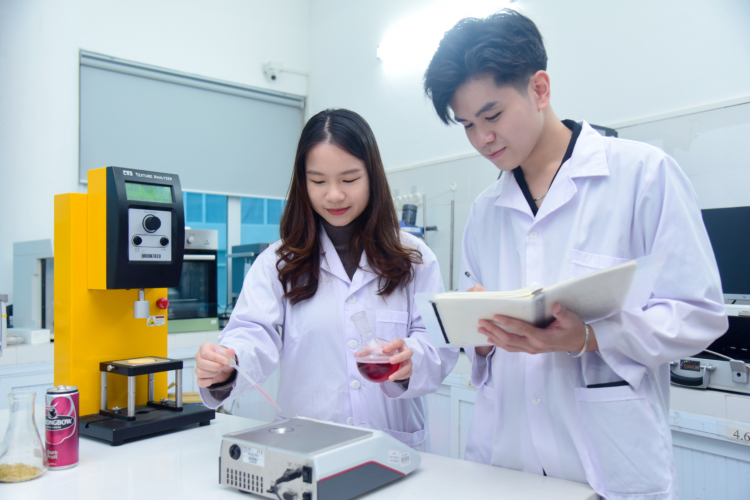
The FST programme at USTH is designed with a modern, comprehensive curriculum encompassing both foundational and specialisation courses, covering the latest techniques and technologies in food harvesting, processing, preservation, analysis, and quality control, in line with the objective of enhancing the added value of Vietnam’s strategic agricultural commodities. Furthermore, the programme integrates a substantial volume of laboratory practicals, field visits, and group projects, providing students with hands-on skills, independent research capabilities, and effective teamwork competencies, enabling graduates to adapt readily to the diverse professional requirements of the food industry.
3. PROGRAMME CURRICULUM
The FST programme provides a comprehensive, unified curriculum that equips all graduates with integrated competencies across three thematic domains:
- Food Processing and Production Technology
- Food Safety, Quality and Regulation
- Food Science, Nutrition and Innovation
All students follow a common course of study acquiring knowledge and practical skills across all three domains. The curriculum additionally includes elective modules, with two offered in the second year and four in the third year, allowing students to deepen their expertise in areas aligned with their professional interests. All graduates are awarded a Bachelor of Science in Food Science and Technology.
A. Common Foundation Modules (60 ECTS)
| No. | Module Code | Module Title | ECTS | Mandatory(M)/ Elective (E) |
| 1 | ICT1.002 | Basic Programming | 4 | M |
| 2 | ICT1.001 | Introduction to Informatic | 3 | M |
| 3 | MAT1.002 | Linear Algebra | 4 | M |
| 4 | MAT1.001 | Calculus I | 4 | M |
| 5 | PHY1.001 | General Physics I | 4 | M |
| 6 | PHY1.002 | General Physics II | 4 | M |
| 7 | BIO1.001 | Cellular Biology | 4 | M |
| 8 | BIO1.002 | Genetics | 3 | M |
| 9 | CHE1.001 | General Chemistry I | 4 | M |
| 10 | CHE1.002 | General Chemistry II | 4 | M |
| 11 | BIO1.004 | General Microbiology | 3 | M |
| 12 | BIO1.003 | Biochemistry | 3 | M |
| 13 | CHE1.003 | Organic Chemistry | 4 | M |
| 14 | CHE1.004 | Practical Chemistry | 2 | M |
|
English modules |
||||
| 15 | ENG1.006 | Academic writing | 3 | M |
| 16 | ENG1.006 | Presentation skills | 3 | M |
| 16 | ENG1.007 | Listening and note taking skills | 2 | M |
|
Management Science Elective – choose 1 of 2 (2 ECTS) |
||||
| 18 | MS1.001 | Foundation Economics | 2 | E |
| 19 | MS1.002 | Fundamentals of Law and Law on Science and Technology of Vietnam | 2 | E |
| Total | 60 | |||
Bachelor – 2nd Year
Mandatory Modules
| No. | Module Code | Module Title | ECTS |
| 1 | FR2.001/002 | French Language (Year 2) | 8 |
| 2 | FST2.004 | Introduction to Food Science and Technology | 3 |
| 3 | FST2.012 | Process and Equipment in Food Technology I | 3 |
| 4 | FST2.023 | Practical in Food Chemistry | 3 |
| 5 | FST2.014 | Food Microbiological Analysis | 3 |
| 6 | FST2.006 | Food Chemistry | 3 |
| 7 | FST2.011 | Food Toxicology | 3 |
| 8 | FST2.015 | Food Safety and Sanitation | 2 |
| 9 | FST2.017 | Food Legislation and Regulation | 3 |
| 10 | FST2.007 | Nutrition Metabolism | 3 |
| 11 | FST2.009 | Food Microbiology | 3 |
| 12 | FST2.010 | Food Enzymology | 3 |
| 13 | FST2.008 | Food Physics | 3 |
| 14 | FST2.005 | Biostatistics | 3 |
| 15 | FST2.016 | Preservation Technology | 3 |
| 16 | FST2.019 | Environmental Safety in Food Industry | 2 |
| 17 | FST2.020 | Introduction to Ecological Agriculture | 2 |
| 18 | FST2.018 | Process and Equipment in Food Technology II | 3 |
| Total | 56 | ||
Elective Modules – students choose 2 of the following 6 modules
| No. | Module Code | Module Title | ECTS |
|---|---|---|---|
| 1 | MS2.006 | Intellectual Property Management | 2 |
| 2 | MS2.005 | Basic Principles of Project Management | 2 |
| 3 | FST2.024 | Food Compositional Analysis | 2 |
| 4 | FST2.025 | Molecular Biology | 2 |
| 5 | FST2.026 | Environment and Public Health | 2 |
| 6 | FST2.027 | Introduction to Phytochemistry and Natural Compounds | 2 |
| Total | 4 | ||
Bachelor – 3rd Year
Mandatory Modules
| No. | Module Code | Module Title | ECTS |
|---|---|---|---|
| 1 | FR3.001/002 | French Language (Year 3) | 7 |
| 2 | FST3.002 | Refrigeration Technology | 3 |
| 3 | FST3.003 | Package Technology | 3 |
| 4 | FST3.006 | Practice on Food Technology | 3 |
| 5 | FST3.005 | Sensory Evaluation of Food Products | 2 |
| 6 | FST3.009 | Dairy Technology | 3 |
| 7 | FST3.015 | Functional Food | 2 |
| 8 | FST3.010 | Beverage Technology | 2 |
| 9 | FST3.012 | Seafood Technology | 2 |
| 10 | FST3.013 | Food Quality Management | 3 |
| 11 | FST3.004 | Food Formulation Technology | 3 |
| 12 | FST3.011 | Aroma and Food Additives | 2 |
| 13 | FST3.007 | Meat Technology | 2 |
| 14 | FST3.020 | Internship | 15 |
| Total | 52 | ||
Elective Modules – students choose 8 ECTS of the following 8 modules
| No. | Module Code | Module Title | ECTS |
|---|---|---|---|
| 1 | MS3.001 | Scientific Writing and Communication | 2 |
| 2 | FST3.028 | Wastewater Treatment in Food Industry | 2 |
| 3 | FST3.014 | Post-Harvest Science and Technology | 2 |
| 4 | MS3.002 | Startups | 2 |
| 5 | FST3.016 | Technology of products from tropical plants | 4 |
| 6 | FST3.019 | Basics of Food Factory Design | 2 |
| 7 | FST3.018 | Statistical Analysis Applied in Food Technology | 2 |
| 8 | FST3.021 | Food Fat and Oil Processing Technology | 2 |
| Total | 16 | ||
4. PROGRAMME LEARNING OUTCOMES
Issued in accordance with Article 5-Chapter II of Decision No. 1292/QĐ-ĐHKHCNHN dated 22 December 2022 by the Rector of the University of Science and Technology of Hanoi.
The learning outcomes of the FST Bachelor’s programme meet the standards set by the ABET educational quality assessment system, as well as the specific outcomes defined at the programme and course levels:
(a) Ability to apply knowledge of mathematics, natural sciences, and engineering fundamentals.
(b) Ability to design and conduct experiments, as well as to analyse and interpret the resulting data.
(c) Ability to design and develop systems within food production processes that satisfy defined requirements.
(d) Ability to work effectively within multidisciplinary teams.
(e) Ability to identify and resolve technical problems arising in real-world food production processes or food safety and hygiene control systems.
(f) Ability to communicate effectively.
(g) Ability to evaluate the impacts of engineering solutions on both the natural environment and society, and their influence on economic development in the context of globalisation.
(h) Ability to apply knowledge of current and emerging food processing technologies and food safety management practices to address real-world challenges in Vietnam and internationally.
(i) Ability to understand and apply principles of professional responsibility and ethical conduct in food science and technology practice.
(j) Ability to design and evaluate innovative food products or processes that satisfy defined nutritional, safety, and market requirements.
5. CAREER OPPORTUNITIES
A Bachelor’s degree in Food Science and Technology from USTH constitutes a strong academic foundation providing graduates with access to a wide range of career pathways in teaching, research, food processing, quality management, and product development across public institutions, private enterprises, and international organisations. Graduate career options include:
- Production line management, quality assurance and quality control (QA & QC) in food processing companies
- Roles in food distribution, import-export, and food product marketing
- Research, quality improvement, and new product development (R&D) in laboratory settings
- Food analysis laboratory technician roles, including food safety and hygiene testing
- Nutrition and food science consultancy
- Food law and regulatory standards advisory
- Food-sector start-ups
Upon completion of the Bachelor’s programme, graduates may pursue postgraduate studies at USTH, including the Master’s programme in Food Safety and Quality Assurance (FSQA), or at partner universities and research institutes in France and worldwide. Graduates have strong prospects of becoming senior specialists, expert consultants, or academic researchers in the food science field both nationally and internationally.
6. PARTNER NETWORK FOR INTERNSHIPS, RESEARCH AND ACADEMIC COLLABORATION
Domestic partners
- Institute of Biology, VAST
- Center for High Technology Research and Development, VAST
- National Institute of Food Control
- National Numbering and Barcode Center
- Vietnam Institute of Agricultural Engineering and Post Harvest Technology
- Faculty of Environmental Science, Hanoi University of Science, VNU
- Nha Trang University
- School of Chemistry and Life Sciences, Hanoi University of Science and Technology
- Nestle Vietnam Ltd. (Bông Sen Factory)
- Ajinomoto Vietnam
- Thai Minh Pharmaceutical Joint Stock Company
- Nutifood Vietnam (Hung Yen Factory)
- Friesland Campina Vietnam (Ha Nam Factory)
- Daesang Duc Viet Joint Stock Company
- Vietnam Beer Alcohol and Beverage Technology Corporation (Vinabeco)
- FBT Joint Stock Company
International partners
- University of Paris Est Créteil (UPEC), France
- University of Lyon 1, France
- University of Montpellier
- Institut Agro Dijon
- INP Bretagne
- Catholic University of Sacred Heart, Italy
- University of Trento, Italy
- Prince Songkla University, Thailand
- National Yang Ming Chiao Tung University, Taiwan
7. CONTACT INFORMATION
– About the training program:
Department of Life Sciences (LS)
Tel: (+84-24) 3212 1576
Email: ls_dept@usth.edu.vn
Add: Room 307, 3rd floor, A21 building, University of Science and Technology of Hanoi
– About Admission:
Department of Academic Affairs (DAA)
Tel: ( + 84-24) 7772 7748
Email: admission@usth.edu.vn
Add: Room 102, 1st floor, A21 building, University of Science and Technology of Hanoi