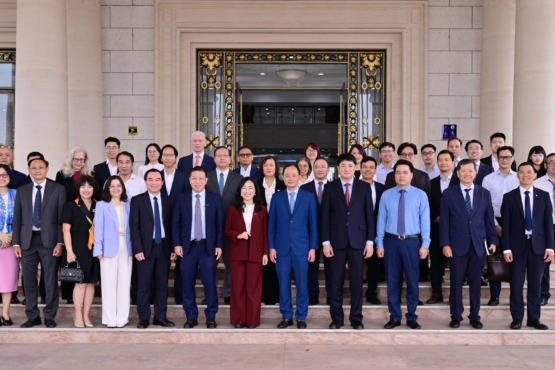
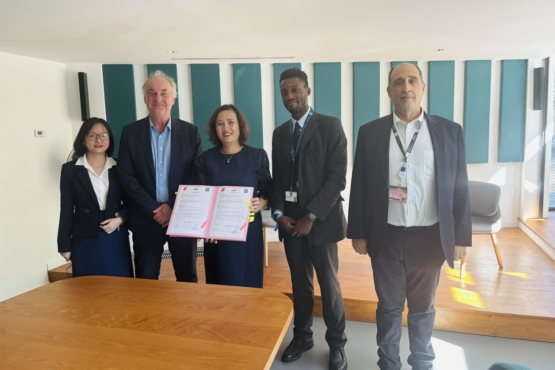
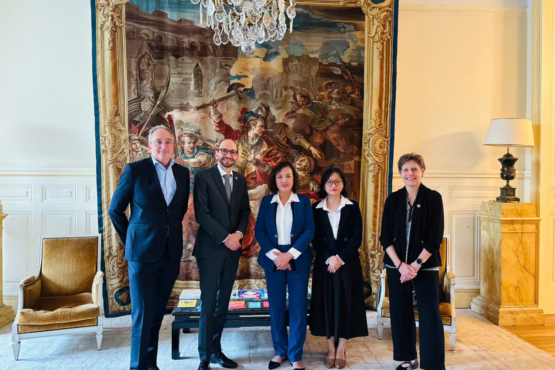
On the morning of September 11, 2026 (local time), in Paris, France, the University of Science and Technology of Hanoi (USTH), under the Vietnam Academy of Science and Technology (VAST), and the French Alternative Energies and Atomic Energy Commission (CEA) exchanged cooperation agreements in the presence of General Secretary and President To Lam.
The exchange of the two cooperation agreements took place as part of General Secretary and President To Lam’s official visit to France, contributing to the concrete implementation of the Vietnam–France Comprehensive Strategic Partnership in science, technology, innovation, and the development of high-quality human resources.
In June 2025, VAST and CEA signed a Memorandum of Understanding during Prime Minister Phạm Minh Chính’s visit to France, establishing a framework for cooperation in scientific research, technology transfer, and human resource development.
To implement the priorities set out in the Memorandum, USTH worked with two CEA entities—the French National Institute for Nuclear Science and Technology (INSTN) and the Fundamental Research Division (DRF)—to develop and sign agreements on education, research and technology transfer. The agreements cover nuclear science and technology, new energy, hydrogen, semiconductors and other areas of shared interest.
The exchange of the agreements in the presence of General Secretary and President To Lam during his visit to CEA holds significant importance. It recognizes the cooperation outcomes achieved to date while reaffirming the commitment of both sides to further expand and deepen substantive cooperation, thereby making a positive contribution to scientific and higher education cooperation between Vietnam and France.
More than a decade of cooperation in energy and advanced materials research
Cooperation between USTH and CEA began to take shape in 2015 through research collaboration and connections between scientists from the two institutions. Their research groups have jointly undertaken a range of activities in energy conversion and storage, particularly hydrogen energy, as well as the design and fabrication of nanomaterials, including semiconductor materials.
Building on these initial results, USTH and CEA’s Fundamental Research Division (DRF) signed a Memorandum of Understanding to formalize research cooperation among scientists and establish a foundation for further strengthening collaboration in energy, environment, materials science, and health sciences. Key areas of cooperation include joint supervision of Vietnamese–French doctoral programs (co-tutelle), lecturer and researcher exchanges, joint organization of scientific conferences and workshops, and opportunities for bachelor’s students, master’s students, and doctoral candidates to undertake internships and research at the laboratories of both institutions.

Mr. François Daviaud, Director of the Fundamental Research Division (DRF), and Prof. Dr. Dinh Thi Mai Thanh, President of USTH, exchanged the cooperation agreement.
An important link in this cooperation is the collaboration between USTH’s Research Group on Chemistry for Energy Conversion and Storage and CEA research units in Grenoble, including LCBM, SyMMES, and MEM. This collaboration has resulted in joint publications in leading international journals such as Nature Materials, the Journal of the American Chemical Society and ACS Energy Letters.
The two sides have also collaborated in doctoral training and supervision, researcher exchanges, and hosting students for internships. Currently, USTH’s Research Group on Chemistry for Energy Conversion and Storage and CEA Grenoble’s LCBM laboratory are co-leading an International Research Project on Hydrogen (IRP Hydrogen), aimed at developing technologies for green H₂ production.
The project was officially launched on February 17, 2025, and will run through the end of 2029, bringing together 26 Vietnamese and French researchers. Both sides expect the project to provide a solid foundation for developing a more ambitious cooperation structure in the future: an international collaborative laboratory focused on renewable energy.
Developing high-quality human resources in nuclear science and technology
Alongside research cooperation in new energy, USTH–CEA collaboration has expanded into education through the French National Institute of Nuclear Science and Technology (INSTN), France’s leading national institution for education and training in the application of nuclear technologies, operated by CEA.
In line with Resolution No. 57-NQ/TW on breakthroughs in the development of science, technology, innovation, and national digital transformation, Vietnam is placing particular emphasis on developing high-quality human resources capable of adopting, mastering, and eventually developing strategic technologies. Against this backdrop, USTH and INSTN have signed a Framework Agreement on cooperation in education and training in nuclear science and engineering.

Mr. Pascal Yvon, Director of the National Institute of Nuclear Science and Technology (INSTN), and Prof. Dinh Thi Mai Thanh, Rector of USTH, exchanged the cooperation agreement.
Under the agreement, INSTN will support USTH in developing and implementing training programs in nuclear science and engineering, as well as in training a core group of faculty members who will directly deliver and further develop these programs at USTH in the future. The two institutions will also collaborate on specialized training courses and the development of teaching and learning materials, while strengthening outreach efforts to attract talented students interested in nuclear science and technology.
In the initial phase, INSTN and its partner universities have agreed to accept outstanding USTH graduates in Chemistry and Materials Science for the International Master’s Program in Nuclear Engineering. The program is jointly delivered by INSTN and leading French universities, including Université Paris-Saclay and Chimie ParisTech, and is supported by major industrial groups such as EDF, Orano, and Framatome.
INSTN and USTH will work together to develop a suitable training program that can accommodate a larger number of students. Under this model, foundational training will be delivered in Vietnam, while advanced study, practical training, and research will be conducted in France.
As early as January 2027, INSTN will send experts to USTH to teach the first course in nuclear science and engineering to the University’s bachelor’s and master’s students.
At a time when Vietnam urgently needs highly qualified professionals in energy and nuclear engineering, cooperation between USTH and CEA will provide a pathway for Vietnam’s access to the knowledge, technologies, and training expertise in a field in which France is among the world’s leading countries in both science and industry.
The exchange of the agreements on September 11, 2026, in the presence of General Secretary and President To Lam, was particularly significant for USTH. It demonstrated the support of the Party and the State for the University’s development into an internationally oriented research institution operating in accordance with global standards.
Cooperation with CEA, one of France’s leading research organizations, is also compelling evidence of USTH’s growing standing within the international scientific community, particularly in France. The French Government has recognized USTH as the most successful of France’s higher education and research cooperation projects abroad (the Franco-X projects). USTH has become a trusted partner in Vietnam for major French universities, engineering schools, and research organizations such as CNRS, IRD, and CEA.
Established under an intergovernmental agreement between Vietnam and France and operating under VAST—Vietnam’s leading institution for scientific research and technology development—USTH will continue to serve as a bridge connecting universities, research organisations and businesses in both countries. Through this role, the University contributes to the sustainable development of scientific and higher education cooperation between Vietnam and France.
| The French Alternative Energies and Atomic Energy Commission (Commissariat à l’énergie atomique et aux énergies alternatives – CEA) was established in 1945 and is one of France’s and Europe’s leading organizations for scientific research and technological development, alongside CNRS, CNES, INSERM, and IRD. CEA plays a key role in fundamental scientific research, technology development, and innovation, while maintaining extensive cooperation networks with universities, research institutions, and high-tech companies.
CEA’s research strengths include nuclear energy, defense technologies, renewable energy, hydrogen technologies, digital technologies, microelectronics, artificial intelligence, and biomedicine. CEA operates 10 research centers located in Saclay (in the Paris region), Grenoble, Cadarache, Marcoule, and other locations. It employs more than 20,000 researchers and staff, with an estimated budget of €6.6 billion in 2025. |