The Master’s program in Advanced Materials Science and Nanotechnology is a two-year program designed to train high-quality human resources in materials science. The program equips students with advanced, in-depth knowledge of materials science, nanodevices, and nanotechnology (nanophysics), as well as materials science and nanochemistry.
1. OVERVIEW
A comprehensive understanding of materials science and nanotechnology is considered one of the key foundations driving the rapid development of various technological fields, with profound impacts on human life.
The program at USTH provides students with a strong interdisciplinary foundation covering materials science, physics, chemistry, and nanotechnology.
The curriculum integrates fundamental scientific knowledge with modern research and development orientations in advanced functional materials. In addition, the program incorporates modules on quality management and control in industrial production, thereby preparing graduates for doctoral studies or professional careers in research and development (R&D) within science and technology sectors.
Students are jointly enrolled at USTH and a partner university in France (Université Paris Cité, Le Mans University). In the first year (M1), students study at USTH in an international environment alongside exchange students from Université Paris Cité. In the second year (M2), 10% of top-performing students have the opportunity to undertake a six-month internship in France. Upon graduation, students are awarded dual Master’s degrees from USTH and the French partner university.
Why you choose this course
- English as the official teaching language
- Well-qualified lecturers from reputable French universities
- Advanced teaching methods
- Opportunities to participate in research projects with lecturers
- Access to International standard laboratories
- Scholarships covering up to 100% of tuition fees, with opportunities for fully funded internships in France
- Exposure to Vietnamese and broader Asian cultural and living environments
List of co-accredited universities
2. PROGRAM
2.1. Training objectives
To train high-quality human resources in materials science, the program equips students with in-depth knowledge of materials science, nano-devices and nanotechnology (nanophysics), as well as materials science and nanochemistry.
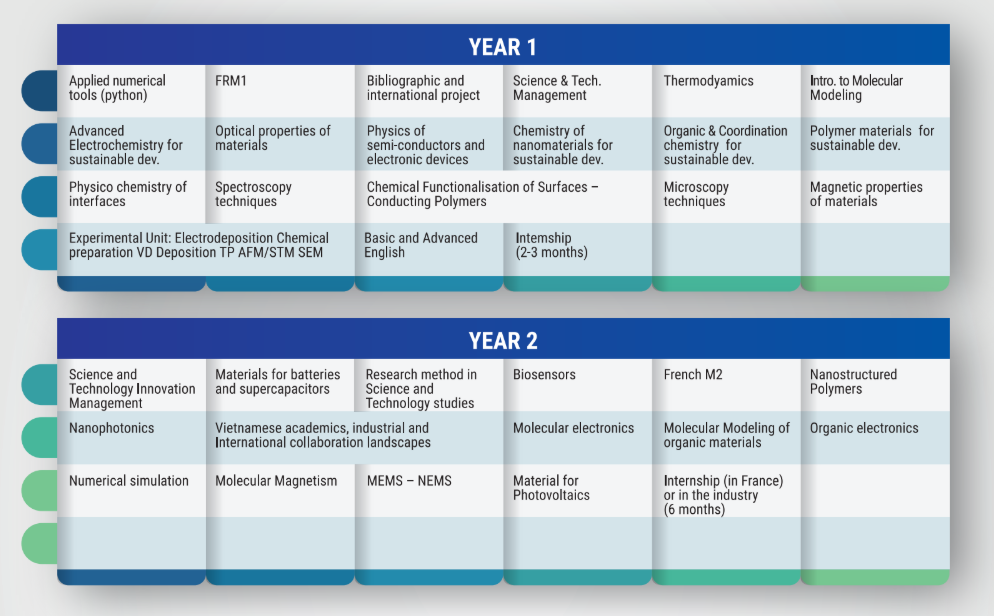
2.2. Program structure
Duration: 2 years (120 ECTS credits), including 30 ECTS for internships
Year 1 (M1): Providing fundamental knowledge in management science, materials science, and materials characterization and evaluation
Year 2 (M2): Providing advanced knowledge in physics and chemistry; advanced technologies for fabrication and characterization; advanced materials for various applications
Specializations: Advanced materials, devices, and nanotechnology; advanced materials and nanochemistry (with both academic and industrial orientations)
Internship: 3 to 6 months at laboratories and research institutes in Vietnam, France, or other countries
2.3. Skills to achieve
- Demonstrate the ability to apply theoretical knowledge to the synthesis, analysis, and evaluation of material properties for practical implementation in advanced materials manufacturing technologies.
- Utilize foundational knowledge in materials science to design and develop novel materials, including polymers, composites, thin films, nanomaterials, magnetic materials, and biomaterials, with applications in industry, agriculture, biomedicine, environmental science, and everyday life.
- Exhibit proficiency in advanced research methodologies for the characterization and evaluation of material properties, and propose innovative approaches to advanced materials processing and fabrication within scientific, technological, and environmental contexts.
- Acquire advanced competencies in problem identification, literature review, and information retrieval, alongside the ability to design and conduct research, prepare scientific reports, and publish findings in peer-reviewed journals.
- Develop the capacity to work both independently and collaboratively, ensure laboratory safety, and effectively operate modern research instrumentation and facilities.
- Demonstrate strong analytical reasoning, critical thinking, and problem-solving skills in addressing specialized challenges in advanced materials science and technology.
- Attain proficiency in English for academic and professional purposes, enabling effective communication and confident engagement in international research and working environments.
2.4. Career opportunities
- Pursue doctoral studies and work at universities, academic institutions, or research laboratories in Vietnam and abroad.
- Work as a technology specialist, scientific and technological consultant, or project manager in fields such as energy products (e.g., solar energy, batteries, LED lighting), healthcare (pharmaceuticals, nutraceuticals, cosmetics), environmental technologies (e.g., water filtration systems, composite materials), and semiconductors (e.g., electronic devices, semiconductor fabrication technologies).
3. CONTACT
– About the training program:
Department of Advanced Materials Science and Nanotechnology
Tel: (+84-24) 32 12 11 62
Email: amsn_dept@usth.edu.vn
Add: Room 304, 3rd floor, A21 building, University of Science and Technology of Hanoi
– About Admission:
Department of Admissions and Communications (DAC)
Tel: (+84-24) 3791 7748
Email: admission@usth.edu.vn
Add: Room 102, 1st floor, A21 building, University of Science and Technology of Hanoi