The Master of Applied Environmental Sciences (AES) program focuses on developing interdisciplinary scientific expertise and practical skills to understand, monitor, and address complex environmental challenges, integrating fieldwork, data analysis, and applied research for sustainable management of water, ecosystems, and environmental risks.
Table of Content
1. OVERVIEW
The AES Master’s program responds to the increasing demand for skilled professionals capable of adressing major environmental challenges, including drinking water and wastewater treatment, hydrological risk management, the study of oceanographic and coastal processes, adaptation to climate change, and the sustainable management of aquatic ecosystems.
To meet these needs, the program offers two specialized tracks: Sustainable Water and Ecosystem Protection (SWEP) and Oceanography and Hydrology (OH). A shared core curriculum provides all students with a solid foundation in environmental sciences, combining theoretical knowledge with hands-on and technical experience.
The program emphasizes advanced technologies for both engineered systems (drinking water and wastewater treatment) and natural aquatic environments, integrating tools such as remote sensing, geomatics, numerical modeling, and environmental engineering. Students also develop strong competencies in environmental data analysis, project management, and applied research methods.
The overarching goal of the AES program is to train future leaders in water sciences and environmental management who can contribute to industry, consulting companies, governmental agencies, and organizations involved in water services, flood and natural hazard prevention, environmental impact assessment, natural resource management, and land-use planning.
The overarching goal of the AES program is to train future leaders in water sciences and environmental management who can contribute to industry, consulting companies, governmental agencies, and organizations involved in water services, flood and natural hazard prevention, environmental impact assessment, natural resource management, and land-use planning.
Graduates are prepared to work across a wide range of sectors related to water resources, aquatic systems, and environmental protection, both in Vietnam and internationally.
The SWEP track train professionals capable of ensuring the sustainable management of water resources and preserving the environment in various contexts, in response to current issues related to climate change, urbanization, and anthropogenic pressures. This track addresses critical issues such as managing water quality and quantity under human and climatic pressures, reducing pollution impacts, and improving integrated ecosystem management practices. Students learn to assess environmental impacts and develop conservation strategies.
The OH track focuses on hydrological and oceanic systems, adopting an integrated approach that combines modeling, remote sensing, and advanced technologies to analyze river dynamics and key oceanic processes. Students develop strong expertise in modeling, data analysis, and programming, while also exploring topics such as marine biogeochemistry, sediment transport, and environmental variability across freshwater and marine environments.
Why should you choose this course
- International double-degree Master delivered jointly by leading French universities and USTH
- Modern, practice-oriented training, including laboratory work, field activities, and applied projects
- 100% of courses in English by professors from top French institutions and USTH
- 6-month professional internship, with high opportunities for placements abroad
- Strong likelihood of obtaining scholarships or fellowships from USTH
- High chance of receiving full funding for internships in France
- Excellent opportunities to apply for fully funded PhD scholarships in France for top-performing students
- Outstanding career prospects in Vietnam and internationally after graduation
List of co-accredited universities with which USTH is associated
- La Rochelle University
- University of Littoral Côte d’Opale
- University of Poitiers
- University of Reims Champagne-Ardenne
- University of Toulouse
- National School for Water and Environmental Engineering (ENGEES Strasbourg)
- National Polytechnic Institute of Toulouse (INP Toulouse)
- Sorbonne University
- Paris-Saclay University
2. PROGRAM
2.1. Curriculum
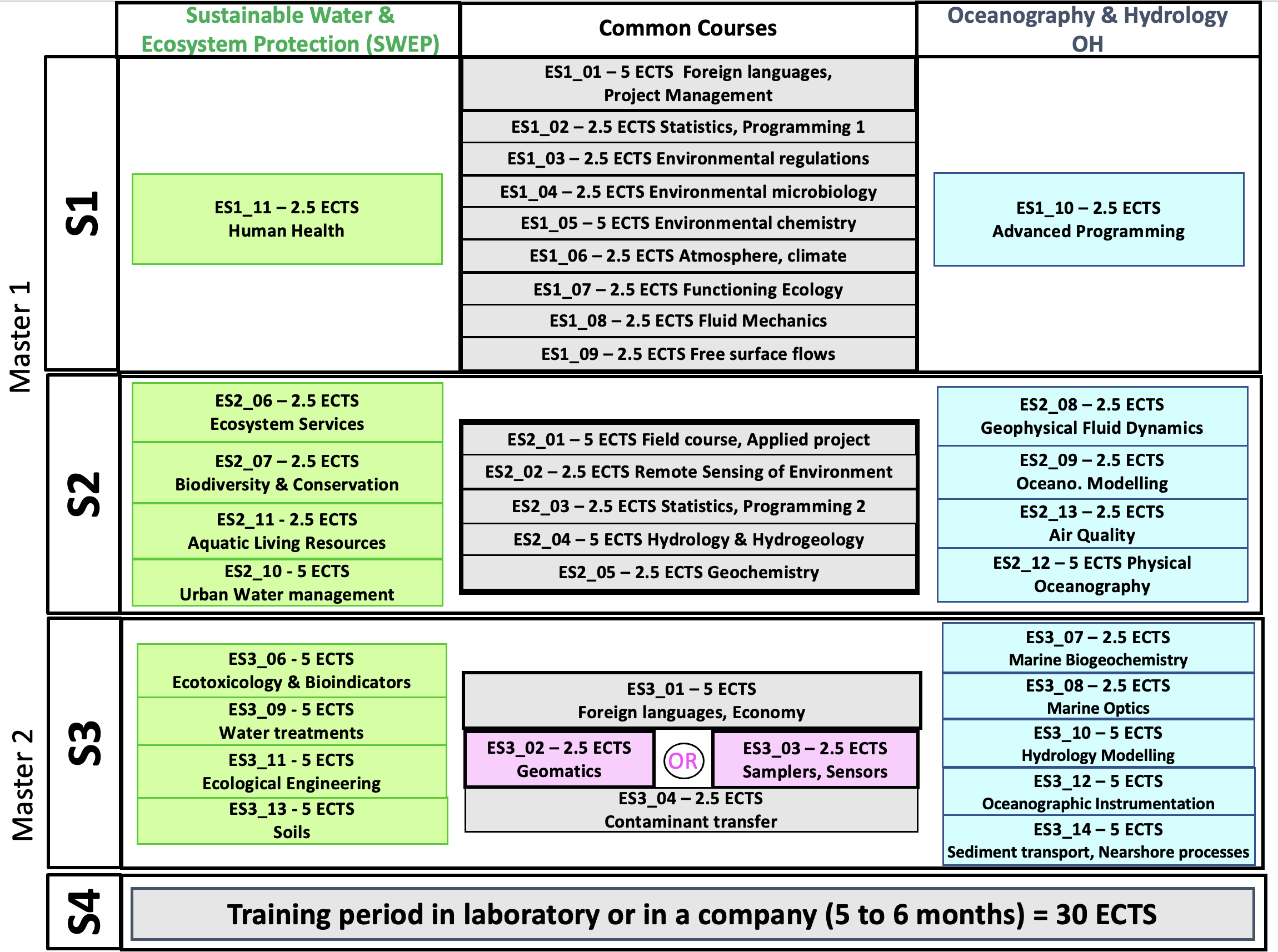
The AES program integrates common courses (middle column) with specialized training in SWEP (left column) and OH (right column), as summarized in the curriculum structure presented below.
2.2. Career opportunities
Types of Jobs :
- University lecturer–researcher
- Research scientist
- Engineer / Environmental engineer
- Project manager
- Production engineer
- Environmental officer / Environmental manager
- Business engineer / Technical sales engineer
Employment Sectors:
- Public sector: Higher education institutions and universities; National and international research organizations; Governmental agencies responsible for water resources management, environmental protection, climate adaptation, and natural hazard prevention; Public laboratories for environmental monitoring, water quality analysis, and compliance control; Regulatory bodies in the fields of water, environment, and sustainable development
- Private Sector: Consulting firms in riverine and marine engineering, aquatic ecosystem management, environmental monitoring, hydrology, and oceanography; Companies specializing in environmental instrumentation, in-situ sensors, numerical modelling, remote sensing, and satellite applications; Laboratories for chemical, biological, and environmental analysis; Industries engaged in water treatment, aquaculture, coastal management, environmental impact assessment, and sustainable resource management.
3. ADMISSION REQUIREMENTS
Vietnamese citizens and foreigners who hold a Bachelor’s degree in relevant fields and meet one of the following language proficiency requirements for admission:
- Obtaining a language proficiency certificate equivalent to level 4* promulgated in the six-level foreign language proficiency framework of Vietnam
- Obtaining a Bachelor’s degree or a postgraduate qualification in English, or in a recognized training program using English as the main language of instruction,
- Having completed USTH’s English Intensive course.
Citizens belonging to one of the following categories may be considered by the Admissions Committee to be admitted to a second year Master’s program (M2):
- Candidates who have completed the first year of Master’s program (M1) at local or international foreign universities following the Bologna process or have completed 240 ECTS-European Credit Transfer and Accumulation System, and pass the application review process.
- Candidates who have obtained Engineering degrees from institutions accredited by CTI/PFIEV, or from other educational institutions recognized by authorities, and must be approved by the Admissions Committee.
- Candidates who have obtained a four-year Bachelor’s degree ranked Good or higher, recognized by the French government as equivalent to the first 60 ECTS after obtaining a Bachelor degree, can pass the application review process, and must be approved by the Admissions Committee with the decision of Rector.
* Conversion table of Foreign Language Degrees and Certificates equivalent to Level 4 of the six-level Foreign Language proficiency framework used in Vietnam for admissions and academic training at Master’s level.
| No. | Certificate/Degree | Level/Score
Level 4 equivalent |
| 1 | TOEFL iBT | 46 – 93 |
| 2 | IELTS | 5.5 – 6.5 |
| 3 | Cambridge Assessment English | B2 First/B2 Business Vantage/ Linguaskill.
Score 160 – 179 |
| 4 | TOEIC
(4 skills) |
Listening: 400 – 489
Reading: 385 – 454 Speaking: 160 – 179 Writing: 150 – 179 |
| 5 | Aptis Esol | B2 |
Admissions method: Application dossier assessment and interview.
4. CONTACT
– About the training program:
Department of Space and Earth Sciences
Tel: (04) 3791.7747/ (03) 3791.8618
Email: sa_dept@usth.edu.vn
Add: Room 308, 3rd floor, A21 building, University of Science and Technology of Hanoi
– About Admission:
Department of Admissions and Communications (DAC)
Tel: (+84-24) 3791 7748
Email: admission@usth.edu.vn
Add: Room 102, 1st floor, A21 building, University of Science and Technology of Hanoi